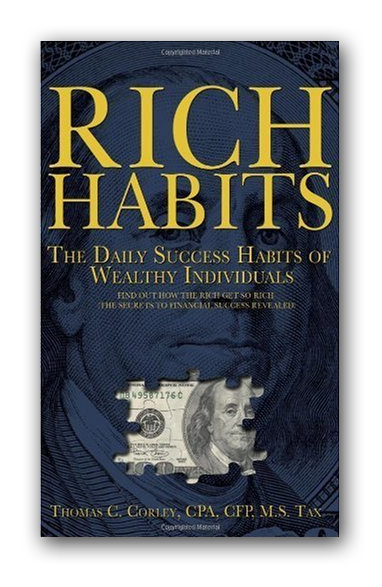
Daily Habits = True Path Towards Wealth

tip-o-the-morning

Tom Corley boats - crop

There is a pervasive obsession with individuals who seemingly come out of nowhere and rise from obscurity to the front pages of newspapers and magazines throughout the world. The media loves to profile entrepreneurs like Elon Musk, Steve Jobs, Warren Buffet, Google Founders Larry Paige and Sergey Brin and Facebook’s Mark Zuckerberg who seemingly rise from ordinary to extraordinary in the blink of an eye. But when you peel the onion, you find out that their overnight success took many years to accomplish. The real truth reveals that such individuals forged daily habits that made their success possible.

Daily habits are a boring topic to most. We yawn reading about individuals who spent years honing their skills every day to the point of excellence. But it is precisely those daily habits that enable individuals to rise from obscurity to overnight success. No one becomes wealthy without daily habits which provide the infrastructure for success to occur. Day after day of reading, learning, practicing and perfecting the skills that eventually result in success are the key to success.

Don’t be seduced by the overnight success story. Barring lottery winners, there simply is no such thing as the overnight success. The only true path towards creating success and wealth is in forging good daily habits. Good daily habits are your transportation system to realizing your dreams.

The Blame Game Anchors You in Failure

tip-o-the-morning

Tom Corley boats - crop

Life has a way of going wrong. Our natural inclination is to blame someone or some thing when life doesn’t go our way. We blame our parents, our spouse, Wall Street, the rich, politicians, the economy, our boss, our company or our circumstances. This knee jerk reaction helps protect your fragile ego by taking individual responsibility for your actions out of the equation. Blame is anchored in negativity and negativity is the default mode for most everyone.

If you were to spend just one day listening to the words that come out of the mouths of others, or listen to your own internal self-talk, you would fill an entire page with blame-ridden excuses. Try it. Spend one day writing down every excuse you hear from others or from your own internal self-talk. It’s worth the exercise. It will open up your eyes. 

Even for the most successful people, things rarely go right. But what separates the successful from the rest of the world is that they refuse to play the blame game. They make a habit of owning their failures and mistakes. It’s not easy to do this, however. Refusing to play the blame game is a habit that must be forged over time. Changing this habit first requires awareness. You must turn your channel and tune yourself in to this negative way of responding to life’s lack of cooperation. Once you do this you will become aware at just how pervasive blame is. Don’t play the blame game. It will only anchor you in poverty and perpetuate your negative mindset. Instead, replace every excuse with the phrase: “I am responsible”. This stops blame in its tracks and empowers you to take future action that will prevent future negative outcomes and will help put you on the path towards success.

Unexpected Consequences – An Entrepreneur’s Best Friend

tip-o-the-morning

Tom Corley boats - crop

In the pursuit of a dream you will have ups and downs. In the very beginning of that pursuit, there will be far more downs than ups. Passion for your dream keeps you in the game, it endows even the laziest individual with superhuman persistence. Eventually, that persistence is rewarded with Opportunity Good Luck – unexpected good consequences.

97% of the self-made millionaires in my study experienced Opportunity Good Luck. Opportunity Good Luck only visits those who never quit up on their dream. Eventually, the persistent get lucky. Unexpected good things occur that transform a dream into reality.

Beware of Groupthink

tip-o-the-morning

Tom Corley boats - crop

Groupthink is the natural inclination of individuals to go along with the thinking, ideologies and activities of the influencers in our lives. It is a part of the Herd Doctrine that I’ve written about often.

Our desire to be liked is hardwired into our DNA. Our brain is always seeking approval from others. It is so pervasive that we will do almost anything to be accepted by others. This desire to fit in often leads us to do things we would not otherwise do, just for the sake of fitting in.

Groupthink will hold you back from living the life of your dreams. Those who do not allow themselves to be victimized by Groupthink blaze their own trail in life. We like to call them self-made millionaires. Self-made’s make a daily habit of swimming upstream. They break free from the Groupthink that holds most back in life. They challenge Group-Thinkers and, as a result, are often subjected to intense criticism. Don’t be a victim of Groupthink. When you think like the group, your success or failure depends on the group. You become a slave to the group. Instead, blaze your own path in life. That’s what self-made millionaires do.

Wealth Finds Explorers

tip-o-the-morning

Tom Corley boats - crop

Talent is important in accumulating wealth. That is why I often write about the need to discover your inborn talents. All individuals, by virtue of their genes, are born with certain talents that set them apart from others. Only through experimentation will you discover what those talents are. You have to throw a lot of mud at the wall and pursue numerous different activities in order to reveal your inborn talents. Most don’t do this. Instead, they focus on two or three activities (baseball, soccer, piano, etc.) and spend most of their childhood years devoted to those limited activities. That formula will never reveal your inborn talents.

But a small percentage are encouraged at an early age by their parents to be explorers and those few lucky individuals eventually stumble upon their innate talents. You know you’ve found an inborn talent because passion always trumpets it’s existence. The brain communicates to us the existence of an inborn talent by infusing us with passion when we engage in the activity. Passion acts like a catalyst in driving us to continuously engage in an activity we were born to do. Passion allows us to focus like a laser in perfecting our skill. Passion gives us the emotional energy that enables us to engage in our inborn talents for many hours every day. Days turn into years and years into decades. Eventually we not only become skilled in the inborn activity, we become expert. And experts are always paid the most.

Those few fortunate explorers who are passionate about what they do for a living are the ones who have discovered their calling in life. Everyone has a calling. So, no matter your age, become an explorer. Only through exploration will you find that which you were born to do. Once found, you will be infused with a passion that will energize you to engage in that activity for the rest of your life.

Work Within Your Willpower Threshold

tip-o-the-morning

Tom Corley boats - crop

When we force ourselves to concentrate on any task we use something called willpower. Willpower is a finite resource. Once our willpower begins to fade, called willpower depletion, our brain tires. We soon find ourselves daydreaming about something else, engaging in bad habits and making poor decisions. Because willpower depletion impairs our thinking, it is important to become self-aware of your own individual willpower threshold. Knowing when you have reached our willpower threshold is important because it can save you from making poor decisions and engaging in bad habits.

Each individual has their own unique reservoir of willpower energy. Some naturally have more, some less. On average, willpower, or your ability to concentrate, lasts between 90 – 120 minutes. When you find yourself hitting the willpower wall you must take immediate action because not doing so can cause you to do things you regret, such as making a reckless spontaneous purchase, caving in on an important negotiation item, or losing control over your emotions. So, what do you do when you begin to exceed your willpower threshold?

When you run out of willpower, you essentially run out of brain fuel – glucose. A quick fix to this is eating something with sugar in it. This immediately boosts your glucose levels and temporarily restores your willpower. This quick fix should only be used in emergency situations because after 20 – 30 minutes you will find yourself even more depleted than before and your thinking even more impaired than before. A better fix is to eat a healthy, high protein meal or take a power nap (30-45 minutes). Eating a healthy meal or taking a nap completely restores your willpower, giving you another 90-120 minutes of clear thinking.

Understanding your willpower limitations helps you make better decisions, avoid bad habits and prevents you from losing control of your emotions, which could damage your relationships.

Making Yourself Recession Proof

tip-o-the-morning

Tom Corley boats - crop

Economic calamities happen. Some are worse than others. Depressions are, by far, the worse type of economic downturn. But they are rare. Recessions, however, are more commonplace. During recessions, millions lose their jobs. In the aftermath of a recession bloodbath, many lose their homes, families are fractured and careers damaged, temporarily or irreparably. During recessions, those affected the worst never fully recover. For them, life will never be the same.

In a given career, an individual could likely expect to face 3 or more recessions. It’s the nature of capitalism. What goes up, must eventually come down. Since the Great Recession of 2008/2009 ended, we have seen anemic economic growth in most parts of the world. The United States, it seems, has fared somewhat better. Still, in the United States, today, there are approximately 30 million who are either unemployed, underemployed or who have given up trying to find work. That is 14 million more than in December of 2007. For these individuals, the Great Recession never ended.

So, if it’s likely that you will have to face future recessions, what can you do to avoid being one of the casualties? Below are five strategies that will not only help you to excel in your career but make you immune to economic downturns. In effect, these strategies will make you Recession-Proof:

  1. Become an Industry Expert – When you become an industry expert you are the last to get fired. You are indispensable to employers, customers and clients. To become an industry expert you need to make a daily habit of growing your knowledge-base. This means not only acquiring new knowledge, but also reinforcing what you already know. To become an industry expert you will need to devote between one to two hours a day to reading and learning.
  2. Create Multiple Streams of Income – Those who fare best during recessions are the ones who have built up over time multiple streams of income. In my research, immunity seems to occur at the point in which you have created at least three streams of income. When you have multiple streams of income, when one more more streams is adversely impacted by a recession, the remaining streams come to the rescue, like knights on a white horse. Building multiple streams of income takes many years, but it virtually guarantees that you will survive a recession, life in tack.
  3. Be a Brand – Those individuals who have successfully branded themselves are the most sought after individuals in any industry. Think Tony Robbins, Taylor Swift, Warren Buffet. While the flood of money into the bank accounts of these individuals may drop somewhat during a recession, they are still in great demand. Companies and events will still hire Tony Robbins for motivational talks; Taylor Swift will still be selling her music and will still be hired by the wealthy for private events; Warren Buffet will still have more devotees than he can manage, investing alongside the “Oracle of Omaha”.
  4. Forge Rich Relationships – Building strong relationships with successful individuals means doors will be opened to you that are closed to everyone else on the unemployment line. When recessions hit, those doors often seem to be padlocked. The more successful individual relationships you forge over time, they more individuals you will have to unlock those doors.
  5. Create Trails – Some call this residual income. Residual income is cash flow that continues to flow to you as a result of previous efforts. Those previous efforts represent assets you have built up or created over time that dispense income. It might be rental income, guaranteed annuity income, dividends, interest income or any number of cash flows coming from your previous efforts of building assets.

Limit Your Priorities

tip-o-the-morning

Tom Corley boats - crop

Every day, day after day, I pursue five things that help move me forward in my dreams and goals. I call it my Daily Five. These are five identical things that automatically pre-populate my to-do list every day.

How many priorities do you have every day? Do you even have any priorities? If you have no priorities than you are like a leaf on a fall day, floating around aimlessly, without direction.

I have found that the magic number of priorities most of the successful individuals in my study were able to tackle is between 3-5 priorities. 3-5 is the magic number. Less than 3 and you won’t get very far on your dreams and goals. More than 5 and you will likely get overwhelmed. Start creating your top 3-5 priorities and automate them on a daily to-do list. The to-do list serves as your accountability partner; your external motivation to get done what you need to get done. Don’t be a leaf on a fall day.

The Ideal Job

tip-o-the-morning

Tom Corley boats - crop

“Skill and passion are often confused for one another, but they aren’t interchangeable. YOu can be really good at what you’re doing, and not be passionate about it, and in fact totally loathe it. So, ask yourself if you are passionate about what you’re doing and, if not, what you are passionate about. What excites you? What gets you going and motivates you to keep going. You will find more personal and professional fulfillment at the place where natural talent and skill meets your personal passion. That is the place where you will find your motivation and be able to maintain it for the long haul.” John Addison, personal development leader and contributor to SUCCESS Magazine.

Luck’s Impact on Success and Failure

tip-o-the-morning

Tom Corley boats - crop

Luck, good or bad, results in success or failure. In my five year study of the habits of the rich and poor (Rich Habits Study), I discovered that luck plays an important role, a critical role, in determining success or failure. In fact, 87% of the rich in my study admitted that good luck, or unexpected good consequences, made it possible for them to amass their enormous wealth. Conversely, 54% of the poor admitted that bad luck, or unexpected bad consequences, forced them into poverty.

But there’s more to the story. The luck that helped forge a life of success for the wealthy was a unique type of luck I have come to call Opportunity Luck. Successful people do certain specific things every day, oftentimes for years, that gives birth to this Opportunity Luck. What I’m talking about is the principle of Cause and Effect. Successful people create the opportunity for good luck by doing certain good things every day, for many years (the cause) and good luck follows (the effect). Good habits, I discovered from my research, are the cause and Opportunity Luck is the effect. This Opportunity Luck is typically something unexpectedly good that occurs while the wealthy are in pursuit of their dreams and goals. Because they go all in and pursue success every day by forging specific good goal habits, eventually they get lucky. Even a blind squirrel can find an acorn if it’s persistent enough. So too with successful people, I found. Persistence, in the application of good daily habits, eventually results in good luck. The key is the persistent application of these good habits. Persistent good habits, or what I call Rich Habits, sets the stage for good luck.

Conversely, poor people create something I have come to call Detrimental Luck. This is another cause and effect type of luck that is the result of doing certain bad things every day, for many years (the cause), and these bad things result in bad luck (the effect). Persistence, in the application of bad daily habits, eventually results in bad luck. The key is the persistent application of these bad habits. Persistent bad habits, or what I call Poor Habits, sets the stage for bad luck.

If you want to change your luck you need to change your daily habits. Rich Habits foster Opportunity Luck and Poor Habits foster Detrimental Luck. Change your habits and you change your luck, which changes your life.