Visualize Action

tip-o-the-morning

Visualization of an outcome does not work. Visualizing actions to be taken to reach an outcome is the only way to realize a goal, major purpose or lifelong dream. Seeing yourself complete the steps necessary in achieving your goals is the key to achievement. While keeping the end in mind is important, more important is the means to those ends. How you get there, the action you must take in achieving your goals, is what you should be visualizing and focusing on.

Start a Relationship Notepad and Become a Relationship Miner

tip-o-the-morning

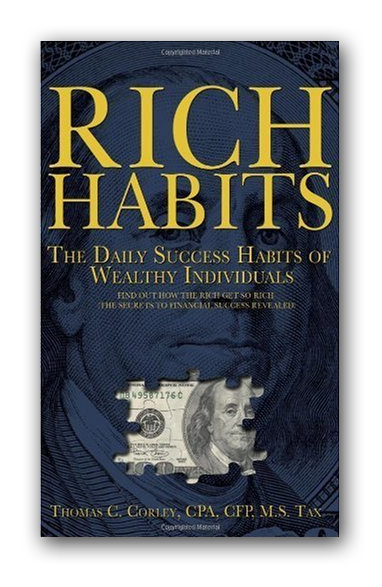
To the wealthy, relationships are like gold. Relationships are the currency of the affluent. Whenever they meet with an old or new acquaintance their objective is to gather as much information about their acquaintance as possible. They ask a lot of questions about the lives of their relationships and make a point of adding that newly mined relationship information to their contact database or cell phone’s contact information. One strategy that will help you turn this into a Rich Habit is to carry around a small notepad everywhere your go to help you gather this relationship information. Mine is incorporated into my wallet – see here: Wallet Crash #5: Tom Corley – Author of Rich Habits –  http://www.budgetsaresexy.com/2014/02/wallet-crash-5-tom-corley-author-rich-habits-rich-habits/ via @budgetsaresexy. The more you learn about those relationships that are important to you, the more opportunity you will have to grow and leverage those important relationships down the road. Start carrying around your notepad today everywhere you go. There’s gold to be found in every relationship. Start mining for it today!

Open-Minded – A Characteristic of Successful People

tip-o-the-morning

One of the most important characteristics of the wealthy, which is responsible for so much of their success in life, is being open-minded. Without it they would be just like everybody else, poor or middle-class. Open-mindedness is what drives their thirst for knowledge and learning. The wealthy are continuously challenging their beliefs. A common response I got from many of the wealthy in my study was, “the more I learn the more I realize how little I know”. This is important mindset because it enables them to pivot quickly to see and take advantage of opportunities that present themselves. If they were stuck in ideological thinking, like 95% of the population, that part of the brain which is engineered to pick up such opportunities (the Reticular Activating System), would never be tuned in to see those opportunities. If you want to become wealthy and successful you need to be open-minded and challenge every one of your beliefs. You need to be open to new ideas and new thinking. You must cast aside the yoke of ideological thinking and pursue knowledge without prejudice.

Delayed Gratificaton

tip-o-the-morning

Successful people invest in themselves. This investment takes three forms:

  1. Taking a risk with their time and money, with a very uncertain outcome.
  2. Devoting time, every day, to learning and perfecting a marketable skill.
  3. Creating something of value to society.

These investments take time to bear fruit and often requires dedicating time every day toward this investment. This may come at the expense of doing pleasurable things in the short-term, but in the long-term the payoff means having more time and more money to enjoy life. Delaying gratification until their efforts pay off is a cost successful people are willing to bear for a better life down the road.

Time to Recover

tip-o-the-morning

Holidays and vacations offer an opportunity to break free from mundane, daily routines. It’s important to shake things up every now and then. Unfortunately, holidays and vacations can derail us from our good daily habits. Success requires that you do the little things every day that move you forward in life. The difference between success and mediocrity in life is that little bit of extra effort. The horse that wins by a nose makes ten times more prize money then the horse that come in second. The same holds true for wealthy people. When your holiday or vacation is over, that is the time to recover. In a day or two you’ll be back on track, headed for your final destination – success!

It’s The Little Things That Cause Success

tip-o-the-morning

It’s the little things you do consistently each day that create success in life. Adopting just one good daily habit is like snowflakes on a mountainside; its benefits build up over time until one day you experience an avalanche of success event. It might be a bonus, new customer, promotion, a job you love, a house by the beach etc. Add just one new good daily success habit today and stick with it for a month. It will make you feel better about yourself and, after a month, you will want to keep doing it. Habits, depending on their complexity, take between 18 and 254 days to become permanent. After about six months, add another new good daily success habit. Each new daily success habit that you form will slowly transform you into a different, more improved person. You will hardly notice the effects of these daily habits but one day, down the road, they will create your avalanche of success event; some unintended consequence that transform you into a bigger, better person.

What are Free Radicals?

tip-o-the-morning

When we eat, our body goes to work breaking down the food and distributing its nutrients throughout the body via the blood. One of the most sought after nutrients in the food we eat is glucose, a type of sugar that is one of the body’s favorite energy sources. Glucose is absorbed into the blood through the small intestines and travels to all parts of the body. The chemical process of tearing apart glucose to extract its energy is a violent process that generates a good deal of toxic waste. This toxic waste consists of a electrons that have been pulled apart from molecules in this violent process. If these electrons are not cleared away inside the body, they will bounce and slam into other molecules within cells and convert them into toxic substances that can mutate our DNA, causing genetic damage that will harm the body. So getting rid of these excess electrons, or free radicals, is a very important task. One of the main functions of oxygen is to soak up these free radicals. Oxygen acts like a sponge, soaking up these excess electrons. Once soaked up, the body magically transforms them into carbon dioxide and the blood then carries this carbon dioxide to the lungs, where it is released inside the lungs and breathed out into the environment.

Laugh Your Way to Mental and Physical Health

tip-o-the-morning

The health effects of laughter very nearly mirrors that of aerobic activity, without all the effort, in the following ways:

  • Laughter decreases the production of cortisol. One of cortisol’s side effects is that it depresses the immune system by reducing the production of lymphocytes – white blood cells. White blood cells are our main defense against viruses, diseases, germs and any parasites that infect the body. By reducing the production of cortisol, laughter actually improves our immune system’s ability to fight off such diseases, germs and defend against parasites.
  • Laughter increases the production of endorphins. Endorphins have the effect of relaxing the body and relieving pain.
  • Laughter improves respiration, thus increasing the level of oxygen intake. Oxygen acts like a sponge, soaking up toxic free radicals (cancer causing elements) within the body and the brain and thus improves brain function.
  • Laughter reduces blood pressure.
  • Laughter improves cognitive ability.

If you have been cramming for a test or preparing for a very important meeting that requires you to think on your feet or solve complex problems, 30 minutes of laughter prior to the test or meeting will increase cognitive ability during the test or meeting. If you want to perform at your best you need to make laughter a daily habit.

Genius is Made Not Born

tip-o-the-morning

Genius is made not born. We all have the capacity for genius. What unleashes genius is the pursuit of some major purpose or goal. Pursuing a purpose or goal comes first and passion comes second. Passion follows the decision to pursue a major purpose or goal. Passion does not come first. You cannot wait to become passionate about something in order to act. You must act first by pursuing a major purpose or setting a big goal.

Sleep Affects Long-Term Memory

tip-o-the-morning

The average adult sleeps 7 1/2 hours a night in five 90 minute sleep cycles. Each of these five sleep cycle is composed of five separate levels of sleep: Alpha, theta, delta, rapid eye movement (REM) and then back to theta. The first three sleep levels last 65 minutes. REM lasts 20 minutes and the final level of sleep lasts 5 minutes. The number of hours you sleep is less important than the number of complete sleep cycles you have when you sleep. Five complete sleep cycles a night is optimal.

Completing less than four sleep cycles a night negatively affects our health. REM sleep is particularly important as it’s primary function appears to be long-term memory storage and restoring oxygen to the cornea. During REM sleep what we’ve learned the day before is transported to the hippocampus. If we do not complete at least four 90 minute sleep cycles a night, long-term memory storage becomes impaired. Completing at least four sleep cycles the night after learning a new skill or the night after studying for a test locks in the new skill or study material. If we get less than four complete 90 minute sleep cycles the night after learning a new skill or the night after studying for a test, it is as if we did not practice the skill or did not study at all because it never fully gets transferred to long-term memory.