Stress Triggers Bad Habits

tip-o-the-morning

Tom Corley boats - crop

In a 2009 study on rats conducted by Rui Costa of the Champalimaud Foundation in Portugal in collaboration with the National Institute of Health, they found that chronic stress acts as a trigger for old habits.

This is an important discovery because the key to habit change is awareness. Being aware of your habits is the stopgap for engaging in destructive habits. If you are aware of the triggers that cause you to engage in bad habits, you can take action to avoid those triggers or to engage in activities that stop those triggers in their tracks before they have a chance to influence your habits.

Chronic stress is caused by external environmental factors. These factors could be almost anything: a demanding boss, deadlines, monthly bills, family, friends, weather, etc. You can feel stress as it is happening. Knowing this, there are things you can do to stop stress and, therefore, prevent bad habits from taking over your life.

For example, suppose deadlines act as a trigger for stress and when you feel stress you have the bad habit of reaching for a cigarette. Procrastination, therefore, is the worst possible thing you can do. The solution is to tackle the project long before the deadline approaches. This will prevent the stress trigger from occurring and thwart the bad cigarette habit.

Awareness of the triggers that create stress in your life and cause you to engage in bad habits, will help you to do certain things that prevent those triggers from occurring.


What Failure Feels Like

Tom Corley boats - crop

The most practical and valuable advice on becoming rich comes from those who tried. Listen closely to those who have tried to pursue wealth. Their lessons are born from the fire of real-world experience.

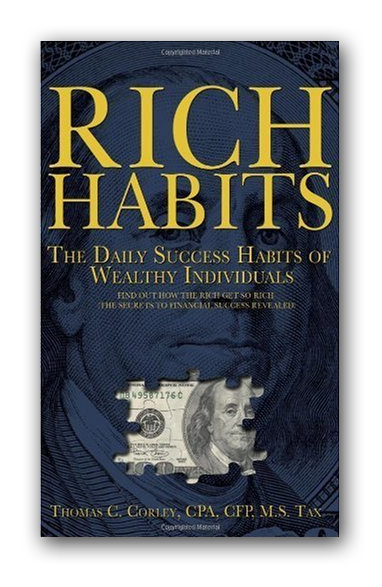
While most of the how to get rich advice I dispense comes from my Rich Habits Study and my books Rich Habits, Rich Kids and Change Your Habits Change Your Life, I am one of those who have tried. More importantly, I am one of those who tried and failed. Failure, I’ve learned, offers the most important lessons.

In  my career, I started four companies. One of those four start-ups failed. This piece will focus on that failure, how it nearly destroyed my life and the lessons I learned from failing. [Read more…]

Wealth = Work and Sacrifice

tip-o-the-morning

Tom Corley boats - crop

I interviewed 361 rich and poor people over a five year period to learn why they were rich or poor. After peeling back that onion, I came to the realization that most people really did not want to become rich.

Becoming rich requires an enormous amount of work and sacrifice. The sacrifice is the investment in time away from family and friends that is required.  It is also, oftentimes, a financial investment, which means taking a risk with your money or leveraging all of the assets you accumulated during your life. This investment and sacrifice is made by almost every self-made millionaire with a zero guarantee that success will occur and wealth will result.

Many who make the sacrifice fail. Some, pick themselves up and try again. And again, and again, and again. Failure is the common denominator in the lives of self-made millionaires.

For most, the work and sacrifice, along with initial failures, is too much to ask. After getting burned by failure and the lack of any return on their investment, most individuals put their tail between their legs and find safe, steady employment, working for those who refuse to quit.

If you were to study this process, as I have, you would come to the conclusion, as I have, that being poor or stuck in the middle-class is a choice. It’s a choice in that the work and the sacrifice, for most, is just not worth it.

The cold hard truth is that those who become self-made millionaires are really very special. They are willing to do the work, make the sacrifices, fail and never quit. If you want a secret to success it is this:

Work, sacrifice, fail and keep working, sacrificing and failing until you succeed


13 Habit Resolutions to Pump Up Your Finances in 2017

Tom Corley boats - crop

If you want to change your life, you must change your habits. In my book Rich Habits I highlight which habits have the most impact over your life and in my followup book Change Your Habits Change Your Life, I explain how to make habit change quick, painless and permanent. Below I share some of the key habits to adopt for the new year along with some of the strategies to make habit change easier. [Read more…]

IQ is Not Fixed at Birth – Habits, Not Genetics, Determines IQ

tip-o-the-morning

Tom Corley boats - crop

Contrary to what you may have been taught, your IQ is not fixed. It can increase or decrease during your lifetime. What causes your IQ to increase or decrease?

A brain cell, also known as a neuron, is made up of the cell body, numerous dendrite branches and one axon trunk. The dendrites receive signals from other neurons. The axon sends signals to other neurons.

As I detailed in my book, Change Your Habits Change Your Life, IQ is determined by the size of your axons, number of dendrite branches and the number of synapses you have. Your axons, dendrites and synapses can increase or decrease during your lifetime. An axon is very much like a tree. It has one trunk with many branches. The size of the axon’s trunk determines your IQ. The bigger the axon trunk the faster that neuron is able to communicate with other surrounding neurons, increasing the number of nearby dendrites that receive axon communications, thereby increasing the number of synapses within the brain. A synapse is when two or more neurons communicate with each other.

When you engage in certain mental and physical activities, the size of your axons grows, the number of dendrites multiply and you increase the number of synapses inside your brain. When your mental and physical activities are limited, your axons shrink, reducing the number of dendrites and synapses.

What activities grow axons, dendrites and synapses?

  • Reading to learn
  • Auditory learning
  • Visual learning
  • Studying (Semantic Memory)
  • Learning a new language
  • Utilizing a new language through repetition or absorption in a new country
  • Traveling – exploring different parts of the world and different cultures (Episodic Memory)
  • Learning a new skill
  • Novelty
  • Daily exercise
  • Engaging in athletic activities
  • Practicing a skill, new or old, repetitively
  • Creative pursuits such as writing, painting, music, engineering, building design, invention, etc.
  • Increasing your communications with others (networking, volunteering, working, social interaction, etc.)

What shrinks axons, dendrites and synapses?

  • Absence of learning (no reading, no auditory learning and no visual learning)
  • Loss of skills due to inactivity
  • Isolation
  • Being Homebound
  • Being set in your ways – absence of novelty
  • Not exercising
  • No athletic activities
  • Watching TV (exceptions: TV shows that teach)
  • Reading Facebook, Twitter, Snapchat, etc. (exceptions: posts that teach)

If you forge daily habits that increase the size of your axons, number of dendrites and the synapses inside your brain, your IQ will grow. Good habits, therefore, can grow your IQ throughout your entire life. Conversely, bad habits can cause your IQ to decrease during your lifetime.

Case Study in Success: Craig Venter, PhD

tip-o-the-morning

Tom Corley boats - crop

You may have heard of the Human Genome Project. This was the government funded effort to sequence the human genome. For nine years Craig Venter worked for the Human Genome Project in their effort to sequence the human genome. He learned some lessons along the way about success that I thought I’d share with you.

Success in any field is about taking risks

Venter grew frustrated with the pace of the government controlled project and their reluctance to experiment with new ideas. His novel “shotgun approach” to sequencing the human genome was soundly rejected by the powers that be on the project. So, taking a huge risk, he quit the project and started Celera Genomics in 1998. He invested all the money he had into Celera. Within 9 months, using his “shotgun approach”, Venter was able to sequence a human genome for the first time.

Believe in yourself and don’t let others opinions define you

Venter was consistently admonished by the powers that be on the Human Genome Project that his “shotgun approach” would not work. Venter never wavered in his belief in his novel approach and that belief eventually would prove them wrong, turning genome sequencing on its head.

Success comes from doing something extraordinary with passion and intensity

Venter’s passion for his unique approach to sequencing the human genome endowed him with an inordinate supply of energy, work ethic, persistence and focus. When you pursue something you are passionate about, success traits you never knew you had, bubble up and help drive you forward in realizing your dream. Pursuing a passion, unleashes your inner success traits.

Passion attracts other passionate people

When Venter left the Human Genome Project to start Celera he soon found many apostles to his cause. Success-minded people are attracted to other success-minded people like bugs to a light. Pursue your passion and you will become a magnet for other success-minded people. Since no one succeeds on their own, the ability to find others who believe in your cause is critical to success.


Hardwired to Create

tip-o-the-morning

Tom Corley boats - crop

Human beings were intended to be creative. It’s hardwired into our DNA. Creative pursuits unleash our inner genius. We all have the creative gene. When we pursue anything creative it triggers positive emotions and creates new neural pathways. Our brains like it when we create new neural pathways so it rewards us with an infusion of neurochemicals that produce a feeling of euphoria. 

In a paper published in the journal Social Cognitive and Affective Neuroscience by researchers at the University of Illinois, Urbana-Champaign, in which the brains of 46 teenagers were scanned, they found that risk-taking teens activated a portion of the brain called the ventral striatum. The ventral striatum is comprised of a large amount of dopamine receptors. Dopamine is the happiness neurotransmitter. It’s clear from many studies like this one, that the pursuit of success will make you happier in life. Playing it safe in life not only prevents you from pursuing success, it also results long-term unhappiness. When we engage in a creative pursuits we are literally turning on the happiness centers of our brain.

In my Rich Habits Study 61% of the self-made millionaires were small business owners. They created something out of nothing. Even more interesting, 80% of those self-made millionaires had devoted much of their adult lives in the pursuit of some dream. And how did they score on happiness? Eighty-five percent of the self-made millionaires in my study said they were happy.

Big deal, you might say, until you find out that 98% of the poor in my study said they were unhappy. Why were the poor unhappy? Because the poor were not creating anything. They were working for others who were doing the creating. 

We are hardwired to create. That’s why the brain rewards us with neurotransmitters that release happiness chemicals. Those chemicals are the brain’s way of stimulating us to create. When we do, we become happy and fulfilled with our lives. When we don’t, we struggle in life.

“I learned this, at least, by my experiment: that if one advances confidently in the direction of his dreams, and endeavors to live the life which he has imagined, he will meet with a success unexpected in common hours.”
― Henry David Thoreau, Walden: Or, Life in the Woods

Rockstar Finance Rich Habits Series – Rich Habit #2 Defining Your Dreams and Setting Goals

rockstar-finance


★ Click Here: Defining Your Dreams and Setting Goals


Under-commit and Over-deliver

tip-o-the-morning

Tom Corley boats - crop

Failing to meet expectations is the #1 cause of unhappiness and discontent.

Successful people make a habit of managing the expectations of those they serve. They understand that failing to meet the expectations of others results in lost clients or lost customers. As a result, they seek to manage expectations others have in them at the outset. They Under-commit and then they Over-deliver.

As a client or customer, when your expectations are exceeded you come back for more. Why? Because you like the feeling. You like feeling happy about the product or service you purchased.

When you make a habit of under-committing and over-delivering, you set yourself up for success. People will pay for anything that brings them happiness. They will loyally pay, over and over again, those who consistently meet or exceed their expectations. The richest and most successful people have a tribe of loyal clients or customers seeking a repeat of the consistent expectations experience they provide.


Money See Money Do

tip-o-the-morning

Tom Corley boats - crop

Habits are contagious. They spread like a virus throughout your social networks. That is why it is critical to surround yourself with individuals who get it and separate yourself from individuals who don’t get it.

Individuals who don’t get it are the ones you see living in big homes, driving expensive cars, drinking coffee from Starbucks, going on exotic and expensive vacations and then posting their pictures on FaceBook. Take a gander at the personal financial statements of those who don’t get it and you’ll see a lot of debt and behind that debt, a lot of stress and unhappiness.

Unwitting observers drool at the sight of those driving their expensive cars. But while you’re drooling, the drivers of these expensive cars are worried about making the next car payment.

Individuals who get it don’t drool. They don’t care what house you live in, what car you drive or how impressive your vacation pictures look on FaceBook.

What they do care about is how much they learned that day from reading, attacking their list of daily habit goals, getting in their daily workout, how much money they saved last month, building more relationships with success-minded people and pursuing their dreams.

These individuals don’t follow the herd. They don’t buy the next new gadget. They only care that their car can get them from point A to point B or that their house is nearly paid off.

Seek out those who get it in life. Avoid those who don’t. Success isn’t complicated. It’s a process. And a big part of that process requires that you surround yourself with the right people; the ones who get it in life.

If you follow the herd and try to keep up with others by emulating their lifestyles, you will ultimately fail in life. Money See Money Do is a loser mindset. It will keep you in debt, create unnecessary stress and leave you feeling unfulfilled and unhappy. Don’t be that person.