You can apply the Rule of 3 to these 5 areas of your life
Develop the Habits to Create Opportunity Luck, Achieve Consistent Success, and Build Wealth
You can apply the Rule of 3 to these 5 areas of your life
If you want to succeed in life, if you want to become rich, you need to understand the success beliefs of the Rich and develop more of these and drop the beliefs of the Middle Class or Poor. 
Beliefs represent the acceptance of something without any proof to back up what we accept as fact.
They are inherited unconscious programming.
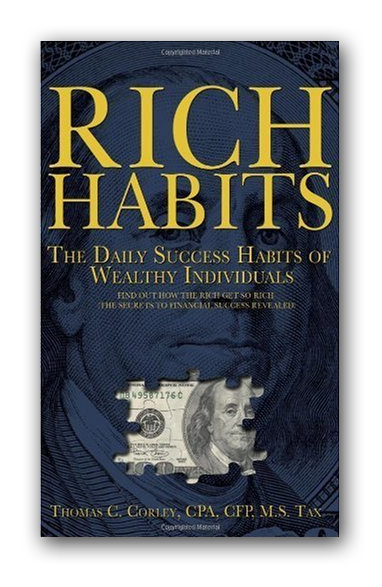
In Tom Corley’s five-year Rich Habits study of 233 rich people and 128 poor people he discovered that your beliefs dictate your circumstances in life.
Those who are wealthy have different beliefs than those who are poor or stuck in the middle class.
Most who were raised in poverty inherited limiting beliefs that hold them back in life.
Those who are able to rise from poverty and become wealthy found mentors who possessed success beliefs or employed certain strategies that enabled them to remove their limiting beliefs and implant success beliefs, effectively re-programming their entire belief system.

In this week’s video we discuss how the wealthy adopt certain beliefs that promote success:
These include:
You can can up with past episodes of this weekly webcast here – Rich Habit, Poor Habits – Tom Corley & Michael Yardney


Habits are amazing things. Once formed, they become automatic, subconscious behaviors that require zero willpower. You don’t need to motivate yourself or pump yourself up to engage in a habit. All it takes is a trigger.
For Abraham Lincoln that trigger was committing something to memory. When Lincoln was studying to take the bar exam, he developed a habit that stayed with him forever.
Lincoln found it difficult to remember all of the legal concepts he needed to know in order to pass the bar exam. So, he decided to write the concepts down a minimum of there times.
After passing the bar, he incorporated this “Rule of 3” into his legal profession. Prior to presenting his case to the judge and jury, Lincoln would write down his arguments three times right before his court appearance. He became so well-respected as a lawyer that he was added to the list of lawyers who could practice before the Supreme Court of Illinois.
Lincoln took his “Rule of 3” with him into politics, eventually becoming the 16th President of the United States in March of 1861. He would write most of his own speeches using his “Rule of 3”. Because of his hectic schedule he would often have to write his speeches on the way to the speech. The Gettysburg Address, one of his most famous speeches, was written on his way to Cemetery Hill, the site of his Gettysburg Address.
When we try to memorize anything, we are using two parts of the brain: the prefrontal cortex and the hippocampus. The “Rule of 3” is a more effective way to memorize facts because it activates three parts of the brain: prefrontal cortex, hippocampus and cerebellum. Lincoln, unknowingly, was using 1/3 more of his brain with his “Rule of 3”, which made it easier for him to commit facts to memory.
If you struggle committing facts to memory, take a page out of Lincoln’s playbook and try his “Rule of 3”. It works. I’ve been using it since 1988 and it has helped me to pass the CPA exam, obtain my Masters degree in Taxation, pass the CFP exam, the Series 7 exam, and has helped me obtain several other licenses. It’s now a habit for me. I’ve incorporated the “Rule of 3” in my Rich Habits business to help me with my speaking engagements and presentations.
Who do you want to be? Have you ever given it any thought?
Sure, we have ideas about what we want to do with our lives. This usually focuses on careers or starting a family so we can become a mom or dad.
At some point, usually around age 45, we begin to wonder if this is all we are in life – our career and a mom or dad. Up to this point we’ve been running like hamsters on a wheel. Working hard at our jobs and raising a family.
But as that family grows up, that wheel starts to slow down, and we suddenly have more time to think about our lives. This “mid-life crisis” event forces us to stop and think about the meaning behind it all. And the inevitable question arises – is this all I am?
Most take a non-productive path and bury themselves in things that occupy their time – new hobbies (golf, boating, crafts, fantasy football, etc.) and/or new addictions (drugs/alcohol/women).
These time-consuming hobbies and the addictions make us feel better while we’re engaged in the activities because they throw a blanket over the real issue and divert our attention. But they only serve to temporarily mask the pain we feel when we are alone with our thoughts.
A few, however, during this mid-life crisis, take the constructive path and begin to formulate a plan to become something more than a job-holder and parent. They pursue dreams and goals that will help them become something more significant in life. They strive for greatness.
We all have the capacity for greatness. But we need a plan to achieve that greatness. I call that plan Dreamsetting.
Dreamsetting will give you the answer to the question who do I want to be. Dreamsetting puts you on the right path in life. It will open your eyes and help you become the person you were intended to be.
I created a short eBook on Dreamsetting. If you’d like a copy, shoot me an email.
There’s a misconception about goals that you’ve no doubt accepted as true. This misconception is that goals represent some future outcome.
Future outcomes are affected by time, changing facts, changing circumstances and unexpected variables that pop up. Future outcomes are actually dreams in disguise, not goals. And this is precisely why so many fail to achieve their goals. They have been defining their goals all wrong.
In my research (Rich Habits Study) I learned that a goal is only a goal if it has two things:
This is the formula I discovered in five-year study of self-made millionaires. In fact, 99% of these millionaires stated that dreams and goals were not the same thing.
Future outcomes do not meet the definition because future outcomes are not 100% certain. You can’t control a future outcome. Too many things could go wrong. Only actions, or behaviors, that you can control are goals.
When you define your goals properly, they act like an elevator, pulling you closer towards the realization of each individual dream.
As an example, let’s say that want to become a CPA (Certified Public Accountant). That’s a dream, not a goal, because it represents some future outcome.
To determine the actual goal, you need to ask yourself two questions:
Study 2 hours every day for the next six months and take the exam
The key to achieving goals, and thus realizing each one of your dreams, is to get clear on exactly what your goals are. Goals are not some future outcome. Goals are actions that require specific skills and knowledge. You must first determine if you have the prerequisite specific skills and knowledge before you define your goal. If you don’t, then you must redefine your CPA goal:
Obtain the skills and knowledge that I need in order to sit for the CPA exam
Once you understand the true definition of a goal, all goals then become 100% achievable. Each dream, such as becoming a CPA, requires that you achieve specific goals. Some dreams require that you achieve multiple goals. Once you achieve those goals, your dream is realized. Then you define your next dream and create goals around that dream.
You dream life is the realization of multiple dreams. It’s like a ladder. Each time you realize a dream, you climb another rung on the ladder. When you realize all of your dreams, you reach the top of that ladder. Your dream life awaits you at the top of that ladder. Achieving goals allows you to climb that ladder. Goals are your transportation system to your dream life.
There are no guarantees of success when you pursue a dream. It’s really hard to turn a dream into a reality.
Ask any entrepreneur who’s tried and failed or tried and succeeded. They’ll tell you straight up that the pursuit of a dream was way harder than they thought it would be. Thank God for rose colored glasses.
But while it’s hard to realize a dream, it is impossible to turn a dream into reality without persistent action. You need to go after your dreams every day by taking action. Persistent action forces luck to happen.
I’ve written often about luck being the key to success. Luck is illusive. It’s like a kid playing hide and seek. When you take action on your dreams every day, however, luck eventually runs out of hiding places.
This is why I emphasize the importance of habits. Habits automate action. When you forge the right habits, the Rich Habits, your actions automatically become persistent. Persistent action forces luck to happen.
The word entrepreneur literally means “bearer of risk”.
But what is risk? Risk is taking action that has two possible outcomes:
When you take risk, you are exposing yourself to either a good or bad outcome.
Most avoid risk because they focus only on the possibility of a bad outcome. Fear grabs them with both arms and prevents them from taking any action at all.
Self-made millionaires, however, are able to overcome that fear. They are like Harry Houdini, able to break free from the grip of fear and take action on their dreams and goals.
Are self-made millionaires simply more courageous than most people?
Not really. They have certain Fearless Habits that enable them to overcome the fear of taking risk:
Here’s why so many self- made millionaires wake up 3 hours before they get to their job.
If you want to succeed in life, if you want to become rich, you need to understand the success beliefs of the Rich and develop more of these and drop the beliefs of the Middle Class or Poor.
Beliefs represent the acceptance of something without any proof to back up what we accept as fact.
They are inherited unconscious programming.
In Tom Corley’s five-year Rich Habits study of 233 rich people and 128 poor people he discovered that your beliefs dictate your circumstances in life.
Those who are wealthy have different beliefs than those who are poor or stuck in the middle class.
Most who were raised in poverty inherited limiting beliefs that hold them back in life.
Those who are able to rise from poverty and become wealthy found mentors who possessed success beliefs or employed certain strategies that enabled them to remove their limiting beliefs and implant success beliefs, effectively re-programming their entire belief system.
In this week’s video we discuss how the wealthy adopt certain beliefs that promote success:
These include:
You can can up with past episodes of this weekly webcast here – Rich Habit, Poor Habits – Tom Corley & Michael Yardney
Successful people are admired in so many ways. They are seen by many as smarter, harder working and visionaries. They are also credited with unique, almost superhuman traits, such as vigorous energy, greater focus, unrelenting persistence, unbridled optimism, unbreakable confidence and superior decision-making abilities.
I have written many times that ALL of those traits derive from one source – passion. Passion turns on all of the success traits that reside inside each and every one of us. But what triggers passion in the first place? Where does it come from?
Emotional Energy is the source of all passion. Emotional Energy endows one with seemingly superhuman powers.
Willpower Energy is the energy most rely on to change their habits and get things done. Willpower Energy, however, is short-lived. It eventually fades away. This is why so many are unable to stick to their New Year’s resolutions. Their Willpower Energy fades away and the new habit eventually fades away.
Emotional Energy, on the other hand, is far more potent and durable (longer-lasting) than Willpower Energy. It is where passion comes from.
There are several types of emotions that spawn Emotional Energy:
Each one of these emotions endows you with Emotional Energy, which liberates your inner passion.