All or Nothing is Unsustainable

tip-o-the-morning

Tom Corley boats - crop

All or nothing shows up once a year in the form of New Year’s Resolutions:

  • Stop drinking alcohol.
  • Stop eating junk food.
  • Stop watching TV.
  • Start exercising every day for an hour.
  • Start reading to learn every day for an hour.
  • Get up at 5am every day.

Invariably, this all or nothing approach, leads to failure, which is soon followed by self-hate, as you berate yourself for being weak and undisciplined.

The correct, sustainable approach, with any new habit, is to baby step your way into it. Small, baby steps that incrementally improve your life in some way, is the right approach.

The right approach:

  • Limit my alcohol consumption to one drink during the workweek (or three drinks during weekends).
  • Limit my consumption of junk food to 300 calories a day.
  • Limit TV consumption to one hour a day. 
  • Start exercising every day for fifteen minutes.
  • Start reading to learn every day for fifteen minutes.
  • Get up 30 minutes earlier.

Those small, baby steps build the neural infrastructure that, over time, take root, eventually becoming lasting, permanent habits.

Your brain will not fight you if the change is small. This is because small conscious changes do not deplete your stores of willpower energy (readily available glucose – the fuel most often used by the body when engaged in any willpower-required activity).

Because small changes utilize very little willpower energy, the brain will not go to war with you and your new habits. This allows you to engage in the habit every day. And every day that you engage in the habit, the habit synapse grows stronger and stronger.

After some time (thirty days or more), that new habit synapse will be strong enough to grab the attention of the basal ganglia, which will eventually designate it as a habit. One this happens, you can then amp up your habit. For example, you can increase your aerobic exercise from fifteen minutes to thirty minutes without the brain engaging in civil war. 

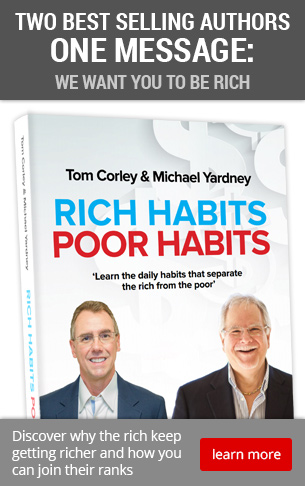
Rich Habits Poor Habits Episode 35 | ‘Want’ Spending Will Put You in the Poor House

How much are your spending habits affecting you level of wealth?

In Tom Corley’s five-year Rich Habits study of 233 rich people and 128 poor people he discovered that your habits dictate your circumstances in life.

He discovered that daily habits dictate how successful or unsuccessful you will be in life.

There are two groups of poor people.

The first group are individuals who simply do not make enough money to meet their needs. money

The second group are individuals whose income exceeds their needs but who, nonetheless, spend more than they make.

According to Census Bureau data, there are approximately 46 million poor people who cannot meet their needs.

They are forced to rely on assistance in one form or another from federal and state governments.

According to this same data, there are approximately 30 million other people who make more than they need but who are, nonetheless, one paycheck away from poverty.

These individuals engage in something called Want Spending.

Want Spenders spend more money than they make on their wants.

They surrender to instant gratification, eschewing saving in order to buy things they want now: 60 inch TVs, nice vacations, expensive cars, bigger homes and jewelry.

ad_rhph

Want Spenders routinely gamble away part of their income.

They also spend too much money at bars and restaurants.

Worse, they incur debt in order to finance their standard of living.

Want Spenders create their own poverty.

They are undisciplined with their money.

They have been brainwashed by advertisers and a consumerist society into buying things they do not need.

When Want Spenders are no longer able to work due to old age, they live out the remainder of their lives in abject poverty.

They become dependent on family, friends, the government or the charity of others.

Their poverty is the byproduct of a Poor Habit known as Instant Gratification.

Want Spenders rationalize their Want Spending in a number of ways:

  • I’ll make more money in the future
  • I’ll get a better paying job
  • I’ll get a second job
  • I’ll get a raise
  • I’ll get a bonus
  • The economy will improve and I’ll make more money
  • I’ll get more clients or customers
  • My children will take care of me in retirement
  • I’ll move to Florida, or some inexpensive place, and live off Social Security

Most people in society do not make a lot of money.

A fortunate few have the Rich Habit known as Delayed Gratification.

These individuals live within their means and do not engage in Want Spending.

These individuals are disciplined savers. lose saving

They diligently save at least 10% of their income, paycheck by paycheck, month by month, year by year.

Their savings grow either by the power of compounding or by prudent investing.

When they retire, they live out the remainder of their lives financially independent, not reliant on financial support from others.

If you’re like most people, you don’t make a lot of money, but the money you do make exceeds your needs.

You have a choice on what you do with this Excess Money.

You can engage in Want Spending, live for today, and rationalize away why you do what you do with your Excess Money.

Or, you can take control of your financial life, by saying yes to saving your Excess Money and saying no to Want Spending.


The Hardest Part is the Start

tip-o-the-morning

Tom Corley boats - crop

The definition of flow: To move, come, or go continuously in one direction.

We all have dreams and big goals. But few ever pursue their dreams and big goals. The main reasons are fear, doubt and discomfort:

  • Fear of the unknown.
  • Fear of failure.
  • Fear of obstacles and mistakes.
  • Fear of losing money.
  • Fear it will disrupt your family life.
  • Doubts of your ability, skill or knowledge.
  • Doubts about achieving the outcome you desire.
  • Survival Doubts: – Will you make enough money to survive financially?
  • New pursuits push you outside your comfort zone.

Self-made millionaires do their diligence in gathering as much information as they can before they make a decision to pursue something they desire. Once they decide to move forward, they take immediate action (see Becoming a Self-Made Millionaire Requires Courage and Faith – http://richhabits.net/becoming-self-made-millionaire-requires-courage-faith/).

The amazing thing about taking action on your dreams and goals, is that action puts you in a state of flow.

Flow is a mental state in which both your conscious mind (prefrontal cortex) and subconscious mind (limbic system and brain stem) work together is seamless harmony.

When you are in a state of flow, your entire brain is working for you to complete a task. When your entire brain is working for you, when you are in a state of flow, creative solutions erupt from within your brain like a volcano. It’s an amazing, unique ability all humans possess.

Very few, however, ever achieve a state of flow. They are too busy working on someone else’s dreams and goals. Flow is easy to achieve when you are working on your own dreams and goals. But in order to tap into this incredible human capability, you must take action on your dreams and goals. The hardest part is the start.

Becoming a Self-Made Millionaire Requires Courage and Faith

tip-o-the-morning

Tom Corley boats - crop

According to my Rich Habits research, self-made millionaires follow a process in pursuing an idea, opportunity, dream or big goal. Typically this is the process:

  1. Idea – This is the first stage in which an idea pops into your head or an opportunity presents itself. This could also be when you gain some clarity on a dream or major goal you’d like to pursue.
  2. Due Diligence – Read books and articles about the idea, opportunity, dream or goal. Then seek feedback from others who have some expertise or knowledge about the idea, opportunity, dream or goal. This stage typically takes the longest because it requires an investment of your time in gathering the necessary information that will help you make a decision on whether or not to take action. This is also the stage in which you evaluate your capability to pursue the idea, opportunity, dream or goal. Do you have the requisite expertise or knowledge? Do you have the skills? Do you have the time? Do you have the financial resources? If not, you obtain what you lack. This could take many months or even years.
  3. Decision – Once you have weighed all of the information you gathered, and acquired the knowledge, skills and financial resources you need in order to pursue the idea, opportunity, dream or goal, you decide to go for it.
  4. Action – Once you decide to pursue the idea, opportunity, dream or goal, action follows immediately.

Almost always, pursuing any idea, opportunity, dream or big goal involves risk. You will never have enough of what you need: time, money, knowledge, skills, etc. So, there is always some risk. You don’t know what you don’t know. So, pursuing success involves significant risk. 

One of the hallmarks of the self-made millionaires in my study was that once they made a decision to pursue something, they immediately took action. Action followed decision. They did not procrastinate. They tossed aside all of their doubts and worries and took action. 

Becoming a self-made millionaire requires courage and faith, since you will never have everything you need when you pursue success.

Efficient Habits

tip-o-the-morning

Tom Corley boats - crop

Habits have a purpose. The brain constantly monitors our activities, thinking and emotions. It if notices a repetitive daily activity, thought or emotion, it will marshall the resources of the basal ganglia, instructing it to transform it into a habit.

The brain converts activities, thinking and emotions into habits in order to mechanize certain activities, thinking and emotions. This not only saves the conscious brain (the neocortex, particularly the prefrontal cortex) from doing work, it also serves to conserve brain fuel (oxygen, glucose or ketones). When activities, thinking or emotions become habits, the subconscious mind (limbic system and brain stem) takes over, which allows the conscious mind to rest. Because the subconscious parts of the brain have been in existence for millions of years, through the process of evolution, it has become very efficient in automating activities, thinking and emotions.

So, the intended purpose of habits is energy conservation and efficiency.

Unfortunately, some unproductive activities, negative thinking and negative emotions can mistakenly be converted to habits by the brain. Watching TV, Facebook, Snapchat, talking/texting on the phone with friends, pessimism, anger, checking email constantly and negative gossiping are unproductive habits which do nothing to benefit your life.

Fortunately, there are certain productive activities, thinking and emotions that can be converted into habits, so long as you engage in them repetitively (typically daily), for at least a month. One month creates the foundational neural infrastructure. If you continue to persist in these productive activities, thinking and emotions, eventually the brain will summon the basal ganglia and instruct it to automate them, transforming them into daily habits.

So, what productive activities, thinking or emotions should you be engaging in repetitively so that they will eventually become daily habits?

  • Aerobic Exercise (Brain and Body Health): 15-20 minutes a day for at least 18 days.
  • Flossing: 18 days or more.
  • Vet Your Thoughts Before They Come Out of Your Mouth: 18 days or more.
  • Positive Gossip: 18 days or more.
  • Reading to Learn (Growth Activity): 15-20 minutes a day for at least 18 days.
  • Happy Birthday Calls (Relationship Builder Activity): 5-10 minutes a day for at least 18 days.
  • Hello Call (Relationship Builder Activity) : 5-10 minutes a day for at least 18 days.
  • Life Event Call (Relationship Builder Activity): 30 minutes a week for at least six months. This is a weekly activity.
  • Time Chunking Activities (Email, Voicemail): 30 minutes each, twice a day (check email and voicemail once in the morning and once in the afternoon). This will take at least six months.
  • Intermittent Fasting (10 – 18 Hours a Day Without Eating): 18 days or more.
  • Healthy Eating: 18 days or more.
  • Develop a New Skill: 254 days or more before you become proficient.
  • Develop a Niche: 254 days or more before you become expert.
  • Develop Positivity (Positive, Upbeat, Optimistic Mindset): 254 days for more.
  • Frugality (Conscious Spending): 254 days or more.
  • Become a Saver: 254 days or more.
  • Control Negative Emotions: 254 days or more.

In order for these productive activities to become daily habits you will need to engage in them at the same time every day. Some activities will become daily habits in as little as 18 days. Others, like aerobic exercise, can take 254 days or more before the basal ganglia will reach out and stamp them habits.

Choice, Not Chance, Determines Your Financial Fate

tip-o-the-morning

Tom Corley boats - crop

The definition of fate is:

The development of events outside a person’s control, regarded as predetermined by a supernatural power.

One of the bad thinking habits of people stuck in a financial rut, is believing in fate. It is a very convenient way to rationalize your current financial circumstances.

Fate is often a crutch, that those struggling financially, lean on. Like a blanket, they wrap it around themselves. This way they are no longer responsible for the financial circumstances of their lives – their poor circumstances are outside their control due to fate.

Those who believe fate controls their financial destiny use code words, phrases or aphorisms to escape the financial responsibility for their lives:

  • “I’m not a member of the lucky sperm club.”
  • “It’s God’s will.”
  • “They’re just lucky.”
  • “I’m not lucky.”
  • “The fickle finger of fate.”
  • “My fate is sealed.”
  • “A twist of fate.”
  • “Predestination.”
  • “It’s because I’m not a man.”
  • “It’s just divine will.”
  • “Life’s wheel of fortune.”
  • “That’s just my lot in life.”
  • “Divine providence.”
  • “It’s God’s plan.”
  • “God loves poor people – that’s why he created so many of them.”

These commonly used words, phrases and aphorisms bleed into your subconscious, programming you to relinquish control over your life to fate.

The fact is, most people who become wildly rich and successful come from poverty or the middle-class. According to the 2016 Wealth-X report, 75% of the rich were poor (19%) or middle-class (56%). In my Rich Habits study, 76% came from poverty (31%) or the middle-class (45%).

How did they break free from poverty or the middle-class? Well, it wasn’t fate:

  • They pursued dreams.
  • They set, pursued and achieved goals.
  • They worked long hours for many years.
  • They were persistence – they never quit on themselves.
  • They were focused like a laser on their dreams and goals.
  • They forged good daily habits that helped move them forward in life towards realizing their dreams and goals.
  • They eliminated any bad daily habits that were holding them back in life.
  • They were obsessed with growth through daily self-improvement: they read books to gain specific knowledge, they practiced every day to improve their skills, they developed valuable new skills, they sought out mentors, they went to night school, etc.
  • They took big risks, others were unwilling to take.
  • They built valuable relationships with other successful people.

Don’t allow yourself to be programmed by society, politicians or family members into believing fate determines your financial circumstances in life. It doesn’t. Accepting “your fate” is just a rationalization to do nothing. Choice, not chance, determines your financial fate.

Experimentation Reveals Your Life’s Calling

tip-o-the-morning

Tom Corley boats - crop

When you experiment with new activities, eventually you will stumble upon an activity that exposes some innate talent or some activity that stirs your passion.

Activity experimentation is like being offered a buffet of diverse foods. At first, you may not know what you want to eat, but if you experiment and eat a little bit of each food, eventually you will taste something you like, something you want to eat.

Some things will bore you. Some things will excite you. Things that bore you lead to unhappiness. Things that excite you lead to happiness. Only through experimentation will you discover what bores you and what excites you.

When you experiment with diverse activities, something amazing happens. Some activities will come easy. When you find an activity that is easy for you to do, that is when you unearth some innate talent. Those activities that come easy, that put you in the flow. They will excite you and you will feel happy when you engage in them. We all have innate talents. Finding them reveals your strengths and finding what you’re naturally good at in life is the key that unlocks the door to success.

Easy to perform activities expose your calling in life – your life’s purpose. When you find your calling, an immediate mental shift will overtake you. It will make you come alive inside. You will want to engage in those activities every day, 24/7.

Those who succeed in life and realize incredible riches, focus on their strengths, their innate talents. They then spend their entire lives engaged in those activities, practicing them, perfecting them, improving them and eventually, becoming expert in them.

People will be happy to pay you a premium for your services or the products you create because they will be the best services or products. They add value to the lives of others, improving their lives in some way.

Experiment. Find your innate strengths. Then devote your life to perfecting them. This will lead to success and wealth.

Rich Habits Poor Habits Episode 22 | What does it take to be successful Part 2

Is success just a matter of luck?
expert leader chess game strategy business win success lose think mind psychology

Despite most people thinking that successful people just got lucky – the reality is it take much more than that.

Rich successful people have developed certain habits and beliefs that have guided them through their.

In Tom Corley’s five-year Rich Habits study of 233 rich people and 128 poor people he discovered that your beliefs dictate your circumstances in life.

The wealthy adopt certain beliefs that promote success.

In this week’s video we discuss 10 habits that successful people posses

These include:

  1. All success requires an optimistic, positive mental outlook
  2. All success requires the development of processes that work
  3. All success requires adding value to the lives of others
  4. All success requires creating a herd of followers
  5. All success requires stepping outside your comfort zone
  6. All success requires laser-like focus
  7. All success requires developing unique skills and the acquisition of knowledge specific to your industry
  8. All success requires creating the opportunity for luck to occur
  9. All success requires the ability to pivot around obstacles, pitfalls, mistakes and failures
  10. All success requires the ability to survive until you thrive

You can catch up with past episodes of this weekly webcast here Rich Habit, Poor Habits – Tom Corley & Michael Yardney

You may also be interested in viewing:

RICH HABITS POOR HABITS EPISODE 21 | WHAT DOES IT TAKE TO BE SUCCESSFUL PART 1

RICH HABITS POOR HABITS EPISODE 20 | NO IS A RICH HABIT

RICH HABITS POOR HABITS EPISODE 19 | IS BEING RICH OR POOR A CHOICE?

RICH HABITS POOR HABITS EPISODE 18 | FEARLESS HABITS OF ENTREPRENEURS


Limit Your Junk

tip-o-the-morning

Tom Corley boats - crop

We all do things we should not do. We all have Poor Habits. However, according to my research, having Poor Habits is not fatal to success and wealth accumulation so long as you limit, or moderate those Poor Habits.

If you have Poor Habits, the solution, therefore is to limit how often you engage in them. Let me give you some insight as to how wealthy, successful people limit their Poor Habits:

Junk Eating/Drinking

According to my Rich Habits research, the wealthy still ate junk food, however, they limited how much junk food they ate:

  • 70% of the wealthy ate less than 300 junk food calories a day.
  • 72% of the wealthy ate candy no more than two times a week.
  • 75% ate at fast food restaurants no more than twice a week.
  • 87% said they never drank alcohol to the point of intoxication.

Junk Reading

Junk reading includes reading for entertainment vs. reading to learn and educate yourself. Here’s some data I gathered regarding this Poor Habit:

  • Only 11% of the rich read for entertainment. The rest, 89% read to learn or educate themselves.
  • 58% of the rich read biographies of other successful people.
  • 51% read history.
  • 55% read self-help.
  • 45% read about finance or money-related topics.

Junk Time

Wasting time is a Poor Habit that the wealthy avoided like the plague. They made productive use of their time by pursuing dreams, pursuing the goals behind their dreams, working long hours, reading, exercising, volunteering for non-profits, coaching sports teams, teaching, going to school, playing competitive sports, listening to podcasts and other activities intended to help them forge relationships with other success-minded people.

Junk Relationships

To the rich, relationships are like gold. In fact, relationships are the currency of the wealthy. They forge power relationships with other successful or success-minded people – people who can open doors for them. They avoided toxic people, negative people, pessimistic people, people who gossip, people with financial problems, people who are untrustworthy, people who lie, cheat or steal.

Junk Words

The rich choose their words very carefully. They vet every thought before it comes out of their mouth. In Kareem Abdul-Jabbar’s book Coach Wooden and Me, Jabbar said he sometimes grew impatient with John Wooden, who would often take long moments to make a point because he was so particular about the words he used. Wooden’s devotion to choosing words carefully is something that was a common habit among the wealthy. The rich in my study made a habit of avoiding the use of words that were critical or words that would offend or demoralize others. Words can build up or tear down relationships. The rich understood this.

Junk Thinking/Junk Emotions

Psychologist Rick Hanson, senior fellow of The Greater Good Science Center of UC, Berkeley has studied something called negativity bias for years. He found that our brains are all hardwired for negativity. Negative thoughts constitute Junk Thinking. Negative thinking includes: pessimism, envy, jealousy, hatred, anger, sadness, worst-case scenario thinking, chronic worry, glass half empty thinking, doubt, ingratitude, victimization, sense of entitlement, hopelessness, blame and fault-seeking. The rich avoid negative thinking because they understand that negativity must be controlled. Otherwise, the roots begin to grow along with the negative thoughts. They embraced positive thinking, positive beliefs. In fact, 71% of the self-made millionaires in my study said that optimism was one of the most critical factors to their success. When it came to their emotions, the rich made a daily habit of controlling their emotions. They understood that losing their temper could derail relationships with other successful or success-minded people. Relationships they spent many years forging.

Junk Talk

Junk talk includes gossip, destructive criticism, cursing, sarcasm, belittling or demeaning others, opinions not based in fact and words said in anger or disgust. The rich avoided Junk Talk because Junk Talk damages relationships and relationships are the currency of the wealthy.

Like any type of junk, it should be hauled away and discarded. Be wary of the junk in your life Limit its existence. Too much junk will turn your life into a junkyard.

Good Partner Bad Partner

tip-o-the-morning

Tom Corley boats - crop

Steve Jobs had Steve Wozniak. Warren Buffet had Charlie Munger. Larry Page had Sergey Brin. Some of the most successful people in the world owe their success to the partnerships they forged.

Finding the perfect business partner is one of those fast tracts to success I love to talk about. In the case of a perfect business partnership, 1 + 1 = 3. What this equation is trying to say is that when two people join forces, that partnership’s potential success can be significantly greater than the individual accomplishments of each partner.

But while partnering is one of the fast tracks towards success and wealth, it is also one of the fast tracks to failure or bankruptcy. Choosing a bad partner can create havoc with your financial and personal life. Bad partnerships lose money, find themselves in litigation and destroy marriages.

So how do you go about finding the right business partner? Below are some questions to ask that will help you identify potentially good business partners:

  • Is your potential partner honest?
  • Is your potential partner humble?
  • Does your potential partner have skills you lack?
  • Does your potential partner have control over their emotions?
  • Is your potential partner sound financially?
  • Does your potential partner have good relationships with his family members? Family includes immediate family as well as parents and siblings.
  • Does your potential partner treat their family members well?
  • Does your potential partner have a hard work ethic?
  • Is your potential partner a rule follower?
  • Have you worked with this potential partner before?
  • Do you know this potential partner very well?
  • Is your potential partner positive, upbeat and optimistic?
  • Does your potential partner have a good reputation?
  • Does you potential partner have integrity?
  • If your potential partner has a spouse or significant other, do you know them well?
  • Is your potential partner a good listener?
  • Does your potential partner have a reputation for keeping their word?
  • Is your potential partner a good learner?

If the answers to these questions is yes, then you have a perfect partner candidate. If you don’t know the answers to any of these questions, do not partner with a potential partner until you do.

Here are some questions to ask that will help you identify potentially bad business partners:

  • Does your potential partner have a reputation for lying? Have you caught them in even little lies?
  • Is your potential partner arrogant?
  • Does your potential partner cheat on their taxes?
  • Does your potential partner have any outstanding tax issues or deficiencies?
  • Has your potential partner ever sued anyone?
  • Has your potential partner ever been sued by anyone?
  • Does your potential partner cheat on their spouse?
  • Do you and your potential partner have similar skills?
  • Is your potential partner quick to anger?
  • Does your potential partner have money problems?
  • Does your potential partner have bad relationships with his family? Family includes immediate family as well as parents and siblings.
  • Does your potential partner treat their family members poorly?
  • Has your potential partner ever been in a failed partnership before?
  • Has your potential partner ever broken any laws before – are they a rule breaker?
  • Has your potential partner ever filed for bankruptcy before?
  • Does your potential partner have any outstanding debts they are behind on?
  • Does your potential partner gossip?
  • Is your potential partner negative, downbeat and pessimistic?
  • Does your potential partner have a bad reputation?
  • Does your potential partner lack integrity?
  • Has your potential partner ever made bad investments in the past?
  • Does your potential partner have any issues with their spouse or significant other?
  • Is your potential partner a poor listener?
  • Does your potential partner exaggerate or have problems keeping their promises?
  • Is your potential partner a poor learner?
  • Has your potential partner ever broken any promises to you or anyone you know?
  • Has your potential partner ever broken any promises to any of their past business partners?

If the answer to any of these questions is yes, this may not be the right partner for you. If you don’t know the answer to all of these questions, do not partner with a potential partner until you do.

Some other points I’d like to make regarding potential partners:

  • Find three or more individuals who have worked with this potential business partner and ask them the above questions. This includes former partners and vendors.
  • Ask your potential partner’s family members these questions?
  • Who does your potential partner surround themselves with?
  • Are their friends standup people or not?
  • Would you associate with their friends?
  • Never partner with someone who surrounds themselves with fools or people who lack integrity.

You will never know everything you need to know about a potential partner, but asking the above questions is good due diligence and will help you to better vet potential partners. Knowing as much as you can know about future business partners significantly reduces your risk. The more you know, the lower your risk. Not knowing as much as possible about potential business partners significantly increases your risk. The less you know, the greater your risk.