One of my recent speaking engagements where I share 15 of the top habits that helped transform 177 ordinary people into self-made millionaires:
Develop the Habits to Create Opportunity Luck, Achieve Consistent Success, and Build Wealth
One of my recent speaking engagements where I share 15 of the top habits that helped transform 177 ordinary people into self-made millionaires:
The rich and the poor share very different ideologies


Some of the greatest historical figures worked diligently at self-assessment and self-improvement.
Benjamin Franklin and George Washington created lists of good behavioral activities to help them eliminate any defects or bad habits they thought they had.
Benjamin Franklin’s list became know as the 13 Virtues of Life. He compiled this list at the age of 20 and spent the remainder of his life trying to live by those virtues.
George Washington’s list is known as the Rules of Civility and Decent Behavior. Washington created this list while still a teenager.
Is it an accident that these two self-improvement fanatics had enormous success in life?
Rich Habit #1 is known as the Self-Assessment Rich Habit. One strategy I uncovered in my research is to create a list of all of your bad daily habits and invert them into good daily habits.
Another strategy I uncovered is the five-year letter. This is a letter you write today about the future you. Included in this letter are all of the qualities and good habits the future you possesses. When done, you have a life plan that will act like a blueprint for pursuing the life of your dreams.
There’s a huge difference between chronic stress and worry.
Chronic stress is an elevated level of anxiety that shuts down part of the brain (pre-frontal lobe), disabling your ability to think clearly. Chronic stress also depresses the immune system, making you vulnerable to viruses and bacteria and susceptible to diseases such as cancer.
Worry, on the other hand, is a mild form of anxiety that does none of those things. We tend to think worry is a bad, negative things. But research shows a little bit of worry can actually help you to succeed in life. Researchers at Ontario’s Lakehead University, led by Alexander Penney, surveyed 126 undergraduate students about their feelings in regards to anxiety, depression and worry. Students who ranked high on the verbal intelligence scale tended to worry more often.
Why is worry good for you?
Mentors are critical to breaking free of poverty or a middle-class upbringing. Almost 92% of the self-made millionaires in my study had some mentor that they could point to who helped them become rich. These mentors taught them new habits, new beliefs, how the rich think, how the rich set and achieve goals, processes that lead to success and tricks that put helped put them on the fast track of success.
Who were their mentors? [Read more…]
I get a lot of emails every day, mostly from readers of my books or blog. But every now and then I get emails from individuals trying to sell something.
The other day I received an email from some “expert” who was bragging about helping an author sell 50,000 books. In the email he was trying to sell their book promotion services to authors.
My first thought was, “how do consider 50,000 books successful?” I then deleted the email.
But it forced me to think about the definition of success. From the perspective of a new author, I suppose selling 50,000 books would be a major success. You see, your perspective affects your definition of success.
If you are eking out a living, struggling to get by, you might view anything that helps you earn more money worthy of pursuing. You might even drop $100 on some scheme that promises if you do X, Y & Z you will be able to earn an additional $500 a month. That $100 could make you $6,000 more a year. It’s worth the $100 and your time. To you that’s a successful investment.
It’s success because of where you started – broke. That $500 a month puts an end to being broke. It alters your circumstances in life.
Now consider an individual who just got a bonus for $100,000. They run across the same ad. And they think to themselves, “why would I invest $100 and my valuable time to make only an additional $6,000 a year?”
So, they ignore the ad. From their perspective, the prospect of making an additional $6,000 in exchange for $100 and their valuable time is simply not their definition of a successful investment.
Your definition of success depends on your perspective. Your perspective is determined by your current life circumstances.
Opportunities for success are all around you. Whether or not you take advantage of those opportunities depends entirely on your perspective. One man’s definition of success is often very different than another’s.
You could be told by 100 different people that you need to lose weight, moderate your consumption of alcohol, read every day in order to grow, call your mother, or (fill in the blank).
Most ignore the advice given by others. Until something happens in your life that opens your eyes and your ears. When your perspective changes on something, you become more receptive to advice.
It may be a visit to your doctor, where you learn that you suddenly have high blood pressure or learn that your liver is unhealthy. Suddenly, you find yourself exercising, eating right and moderating your consumption of alcohol.
You might get fired from your job. Suddenly, you find yourself reading more about the things you need to know in order to become more expert in what you do.
You might learn that your mother is unhealthy. Suddenly, you find yourself calling her every day.
Those who succeed in life are perpetual students. Their eyes and ears are always open. They don’t wait until the timing is right in order to take the advice of others.
Keeping your eyes and ears open to advice is a Rich Habit. It takes practice to develop this habit.
Don’t be like everyone else and wait until some outside event forces you to open your eyes and ears to advice. Make it a daily habit of being open to the feedback and advice of others.
How?
Create an Advice Binder. In this binder you write down all of the advice you get from others. Then review your Advice Binder once a week. This keeps your eyes and ears open to advice. This habit will help program your mind to do the right things in life; to live your life in such a way as to avoid having to face circumstances that force your eyes and ears to open up.

Good money management is all about creating a budget and sticking to it, right? Well, you might be surprised to see what else is involved.
By Maryalene LaPonsie | Contributor Aug. 12, 2016, at 12:19 p.m.
If you want to live the good life, financially-speaking, you might expect to need a job that pays well and a plan for how to responsibly spend the money you earn. However, there could be more to it than that.
Your health habits, friends and even how many times you check your credit score could all have an impact on your financial security. Here’s a closer look at five things that have a surprising effect on your money situation.
Smoking and your other bad habits. When you think about it, it’s not too surprising that spending money on a habit means less cash is available to save or invest. In case there was any doubt, Jay Zagorsky, an economist at The Ohio State University, published research in 2004 that demonstrates heavy smokers have a net worth that is $8,300 less than non-smokers. The net worth for light smokers was $2,000 less than non-smokers. On average, smokers had a 4 percent decrease in wealth for each year they lit up, a number that is roughly the same as what an average smoker might spend on his or her habit each year.
[See: 10 Painless Ways to Save More for Retirement.]
“The study was done a few years ago, so the numbers are different now,” Zagorsky says. He also stresses that the study doesn’t prove smoking causes less wealth, but it does suggest a link. When asked if the research could apply to tobacco-less products, Zagorsky says, “My guess is e-cigarettes are the same.” While there isn’t research on every bad habit, it might be safe to assume other behaviors, such as $5-a-day latte habit, could have a similar effect. “Adding an extra habit just reduces your wealth,” Zagorsky says.
ADVERTISING
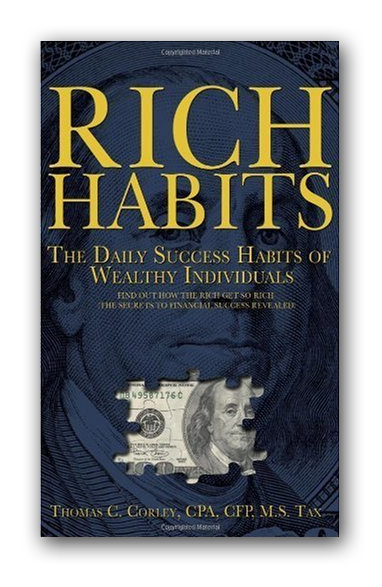
The company you keep. Thomas Corley, author of “Rich Habits – The Daily Success Habits of Wealthy Individuals,” says people can end up in “poverty by association.” In other words, if they spend their time with friends and colleagues who have poor money habits, they may pick those up for themselves. “I actually believe bad habits are a function of your environment – the household you grew up in and the neighborhood you live in,” Corley says. If your friends spend each weekend dining at expensive restaurants or shopping at the mall, chances are you will, too, a practice that could quickly deplete your bank account.
Fortunately, the effect of friends can work the opposite way as well. Frugal friends can help you keep spending in check or offer accountability for a common goal such as getting out of debt. “Surround yourself with people who have the habits you want to adopt,” Corley says.
[Read: 5 Ways to Break Your Bad Money Habits.]
How you were raised. While people can control their friends, they have less control over their family, who can also have a significant impact on a person’s ability to build wealth. “I’m 100 percent convinced habits are a function of early upbringing,” Corley says. Children raised in households where parents gambled excessively, maxed out credit cards or took out payday loans may grow up to do the same.
That can be discouraging for people raised in these households to hear, but Corley believes they aren’t necessarily destined to repeat the financial sins of their parents. “Just because I’m born into certain circumstances doesn’t mean I’m stuck in them for the rest of my life,” he says. Having awareness of those bad habits and making a conscious commitment to avoid them is key.
Checking your credit score regularly. Obsessing over your credit score could actually help you increase the number. “Consumers who are more aware of their credit score are more motivated to improve it,” says Laks Vasudevan, vice president of products and innovation for Discover.
The credit card company recently surveyed 2,000 adults and found 76 percent of those who checked their credit scores at least seven times a year said their number had greatly or slightly improved in the previous year. “We believe knowledge is power,” Vasudevan says, adding that Discover has recently begun providing free credit scores on its website to all consumers regardless of whether they are cardholders.
Buying what you want, when you want. Spontaneous spending comes with a couple of pitfalls, according to Corley. “A lot of people have a poor habit of buying things they don’t need,” he says. Not only that, but they may not put a lot of thought into the price either.
“The poor don’t track their spending,” Corley says. “They have absolutely no idea if they are paying too much for something.” This type of on-the-fly buying has the potential to financially wreck people if they have limited funds and then spend what little they do have on unnecessary or overly expensive purchases.
[See: 10 Costs You Can Eliminate in Retirement.]
Being a more thoughtful consumer won’t instantly transform a person’s bank account, but it will create momentum toward a more financially stable future. Checking your credit score and quitting your expensive habits won’t hurt either.
Listen to my latest interview with Caroline Stephens. Caroline interviews individuals who are pursuing success and their dreams.
Caroline is your unbiased voice on what it takes to achieve success.
With a degree in Asian studies and a strong professional background in journalism with the ABC, her investigative skills have been highly coveted by a variety of different organisations, including the 7.30 Report TV show. She is now the host of the Talking Trading radio show.
Caroline is one of the founding partners of www.talkingtrading.com.au and her role as CEO enables her to develop dynamic trading friendships with market experts so that she can empower the traders who turn to her for advice and counsel.
Her passion for investing and bringing people towards financial freedom as well as her keen eye for a newsworthy story will ensure that you’ll be enthralled with each and every episode Caroline hosts.
Every year, as summer comes to a close, millions of parents around the country shake off the lazy days of summer to see their kids off to college. Whether their kids are just starting out or returning to college, emotions run high. As does the stress. The financial stress, that is. Some colleges make it easier than others to make those college payments but no matter how you slice it, college costs today are a real financial burden on parents.
When I made my last college payment for my youngest last year, my wife and I felt like prisoners that had just been released after eight years of incarceration. Somehow we survived. Somehow we got our three kids through college on a middle-class income.
I thought I’d share with you the details of what it cost us personally to make that happen. I’m hoping this information will help open your eyes to the real costs of college. I’m also hoping it will motivate you to start planning and saving for college right now.
By the way, like many Americans, we had delusions that our three kids would either get academic or athletic scholarships. One did and, as you will see below, it barely made a dent, thanks to all of the other costs, besides tuition, that parents have to contend with. Put your seat belt on this is going to be painful. [Read more…]