Dad’s Advice to His Children on Finding a Purpose in Life and on Being Happy

This is a letter I decided to write and give to my three children who are going to be graduating college soon or have recently graduated.


Dear Kids:

You have all grown up so fast. I’m struggling with the fact that in a few short years you will all be out of the house and on your own. You will learn that life has its ups and downs. The ups will make you happy and the downs, unhappy. Some things that create these ups and downs are outside your control but, thankfully, most things are within your control. I’ve often told you that how you live your life determines your success and happiness. You’ve heard me say many times that your daily habits are the key to a great life.  If you have more good daily habits than you have bad daily habits life will be good, you’ll be successful and you won’t have to worry about money.  I think you all got that message. But there’s one more message I want to share with all of you before you set out on your own. It has to do with finding your main purpose in life and happiness. One of the things I’ve learned over the years is that when any one of you are unhappy your Mom and I are also unhappy. So I am being selfish here. I want all of you to be happy so your Mom and I can be happy as well.

Happiness is elusive to so many. Most people are, in fact, unhappy.  Henry David Thoreau said it best when he wrote: “Most men lead lives of quiet desperation…”. Most people who are unhappy are unhappy because they are struggling financially. They are struggling financially because either they are living beyond their means or their job simply does not provide them with a sufficient income. Odds are, when you are not making a sufficient income at your job, it is because you are doing something you do not particularly like. When you can earn a sufficient income doing something you enjoy you have found your main purpose in life and you will be happy. But how do you find your main purpose in life? Believe it or not finding your main purpose in life is within your control. Here’s the process:

  1. Make a list of everything you can ever remember that made you happy in life. Hopefully, this will be a long list.
  2. Now highlight those items on your list which involve a skill.
  3. Assign a job-type designation to each of the highlighted items.
  4. Next rank each of the highlighted items in terms of happiness with #1 being the greatest happiness and #2 the next greatest happiness and so on.
  5. Now rank each of the highlighted items in terms of income potential with #1 being the highest income and #2 being the next highest and so on.
  6. Total the two columns. The lowest scores represent your main purpose in life.

Here is an example:

This is a guide for selecting that job which will give you the greatest chance for happiness. Pilot each job for six months. You will know that you found your main purpose in life when your job does not feel like a job at all. You will know when time flies by and before you know it the day is over. You will know when you keep making more and more money at your job. You will know when you are happy.


I love you very much,

Dad


The Wealthy “To Do” List – How the Rich Plan Their Day

In my five year study on the daily habits of the rich and the poor I tracked over 300 activities that separate these two groups. When it comes to planning their day and getting things accomplished, the wealthy and the poor see and do things very differently.

Let’s take a look at the research:

  • 62% of the wealthy are focused on their goals every day vs. 6% for the poor
  • 67% of the wealthy put their goals in writing. 83% of the poor do not
  • 73% of the wealthy plan out their day vs. 3% for the poor
  • 81% of the wealthy, who do plan their day, maintain a daily to do list. Less than 1% of the poor use a daily to do list

The daily to do list is one of the tools the wealthy use to prevent procrastination, accomplish their goals and maintain control over their day. They set a daily goal of accomplishing 70-80% of the tasks on their daily to do list. Why? There are three reasons:

  1. The wealthy understand that, at the very least, procrastination can result in poor quality products or services leading to unhappy customers/clients, causing a loss of those unhappy customers/clients or. At the very worst, procrastination can result in litigation, from customers/clients who were damaged in some way by those poor quality products or services.  Procrastination can cause a loss of income. Wealthy people understand that you cannot become wealthy if you procrastinate.
  2. To do lists help the wealthy accomplish their short-term and long-term goals.
  3. To do lists give the wealthy control over their day and their lives.

There are two types of daily to dos:

  1. Goal To Dos – These are daily tasks tied to monthly, yearly and long-term goals. These are almost always fixed in nature, meaning the same to dos show up every day on the to do list. For example: “Make Ten Telemarketing Phone Calls”.
  2. Non-Goal To Dos – These are to dos that are unrelated to any goals. They may be administrative tasks (i.e. Respond to Emails), client tasks (i.e. Meeting with Client) or daily obligations (i.e. Go to Bank). They may be fixed, daily tasks or they may vary daily.


Tip o’ the Morning to Ya – Gossip is a Poverty Habit

tip-o-the-morning

Rich Habits Word of the Day

Gossip – Malicious talk, to defame someone behind their back. Abby loved to gossip at work and eventually she lost the trust of her colleagues and was soon terminated.

Rich Habits Fact of the Day

Dave Ramsey, famed radio personality and best known as American’s #1 money expert, maintains a policy at work that prohibits gossip. Year after year Ramsey’s office ranks as one of the best places to work.


Image: Jost Ammam

Before the introduction of printing all books were painstakingly hand-written. This time-consuming and highly-skilled process meant that books were extremely expensive and an unthinkable possession for many average people. Changing all this was a German goldsmith named Johannes Gutenberg, who in 1440 invented the printing press. His contraption would become one of the most influential inventions in the entirety of human history.

– See more at: https://www.globetask.com/time-management/10-greatest-time-saving-inventions-in-history/#sthash.0bEQwXUl.dpuf

The Printing Press


Image: Jost Ammam

Before the introduction of printing all books were painstakingly hand-written. This time-consuming and highly-skilled process meant that books were extremely expensive and an unthinkable possession for many average people. Changing all this was a German goldsmith named Johannes Gutenberg, who in 1440 invented the printing press. His contraption would become one of the most influential inventions in the entirety of human history.

– See more at: https://www.globetask.com/time-management/10-greatest-time-saving-inventions-in-history/#sthash.0bEQwXUl.dpuf

Rich Habits Lesson of the Day

Wealthy people do not gossip and poor people do. 79% of the poor in my study admitted they like to gossip. Gossip is a Poverty Habit because when most people gossip they do it in a malicious way. When you gossip you lose the trust of those around you and this affects all of your relationships.

Tip o’ the Morning to Ya – Living Below Your Means – The “80/20 Rule”

tip-o-the-morning

Rich Habits Word of the Day

Frugal – Thrifty, penny-wise. Warren Buffet was taught by his parents to live below his means. Consequently, he is considered by many to be frugal.

Rich Habits Fact of the Day

When Jay Leno was a kid he had two jobs. He would spend money he made from one job and save 100% of the money he made from the second job. To this day Leno does the same thing. He lives on the money he makes as a comedian, and  puts all the TV money in the bank. He’s never spent a dime of his TV money.


Image: Jost Ammam

Before the introduction of printing all books were painstakingly hand-written. This time-consuming and highly-skilled process meant that books were extremely expensive and an unthinkable possession for many average people. Changing all this was a German goldsmith named Johannes Gutenberg, who in 1440 invented the printing press. His contraption would become one of the most influential inventions in the entirety of human history.

– See more at: https://www.globetask.com/time-management/10-greatest-time-saving-inventions-in-history/#sthash.0bEQwXUl.dpuf

The Printing Press


Image: Jost Ammam

Before the introduction of printing all books were painstakingly hand-written. This time-consuming and highly-skilled process meant that books were extremely expensive and an unthinkable possession for many average people. Changing all this was a German goldsmith named Johannes Gutenberg, who in 1440 invented the printing press. His contraption would become one of the most influential inventions in the entirety of human history.

– See more at: https://www.globetask.com/time-management/10-greatest-time-saving-inventions-in-history/#sthash.0bEQwXUl.dpuf

Rich Habits Lesson of the Day

85% of the wealthy in my study stated that they have always believed that no matter what an individual can always save money if they really want to. Only 2% of the poor share this opinion. As I’ve shared in many of my success articles, there are three ways to become rich and one of those ways is applying the 80/20 Rule. You save 20% of your net pay and you live off the remaining 80%. The wealthiest in my study were taught this Rich Habit by their parents.

Tip o’ the Morning to Ya – Rich Thinking

tip-o-the-morning

Rich Habits Word of the Day

Defeatism – To think negatively. Tom struggled to stay positive every day but occasionally he could not shake his mind’s defeatism tenancies.

Rich Habits Fact of the Day

At age of 22, Oprah Winfrey was fired from her job as a television reporter because she was “unfit for T.V. ” Winfrey was terminated from her post as co-anchor of the 6 o’clock weekday news on Baltimore’s WJZ-TV after the show received low ratings. Winfrey has called it the “first and worst failure of her TV career.” Winfrey was then demoted to morning TV, where she found her voice and met fellow newbie Gayle King, who would one day become her producer and editor of O, The Oprah Magazine. Seven years later, Winfrey moved to Chicago, where her self-titled talk show went on to dominate daytime TV for 25 years, and ultimately head her own channel, OWN.


Image: Jost Ammam

Before the introduction of printing all books were painstakingly hand-written. This time-consuming and highly-skilled process meant that books were extremely expensive and an unthinkable possession for many average people. Changing all this was a German goldsmith named Johannes Gutenberg, who in 1440 invented the printing press. His contraption would become one of the most influential inventions in the entirety of human history.

– See more at: https://www.globetask.com/time-management/10-greatest-time-saving-inventions-in-history/#sthash.0bEQwXUl.dpuf

The Printing Press


Image: Jost Ammam

Before the introduction of printing all books were painstakingly hand-written. This time-consuming and highly-skilled process meant that books were extremely expensive and an unthinkable possession for many average people. Changing all this was a German goldsmith named Johannes Gutenberg, who in 1440 invented the printing press. His contraption would become one of the most influential inventions in the entirety of human history.

– See more at: https://www.globetask.com/time-management/10-greatest-time-saving-inventions-in-history/#sthash.0bEQwXUl.dpuf

Rich Habits Lesson of the Day

Thoughts become things. Our thoughts are responsible for our success or failure in life. If you think negative, defeatist thoughts you will fail in life. Like attracts like. Negative thoughts say to the world, “I am thinking this way because I want negative things in my life.”  Every successful person has failed or run up against one roadblock after another. If they accepted a negative, defeatist attitude they would have certainly quit. You don’t quit because the going gets too tough. You quit because you allow negative thoughts to talk you into quitting. Your intuition tells you to do “X”. When you allow negative thoughts to dominate your thinking intuition no longer works. Intuition is the communication method of the universe. Successful people have intuition because they live in a positive, upbeat, never say die world.

Breaking Bad ………….. Daily Habits

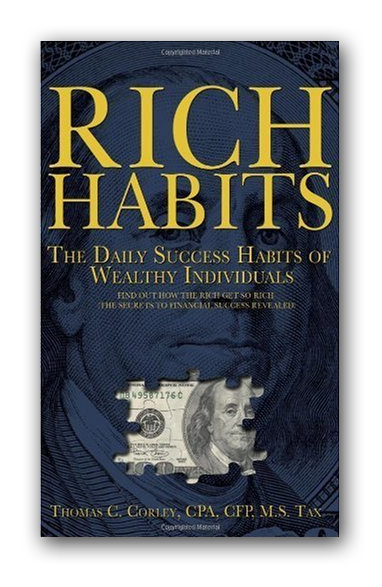
It doesn’t matter if you are rich or poor. Everyone has good habits and bad habits. Good habits will make you rich. Bad habits will make you poor. This is why I refer to them as Rich Habits and Poverty Habits. If you want to be successful in life you need to have more good habits than bad habits. Habits, whether good or bad, are hard to change. Experts debate how to change a habit and how long it takes. I’m here to tell you to forget about trying to get rid of your Poverty Habits by force of will. It doesn’t work. Instead, focus on adding a couple of Rich Habits.

Here’s why. Life is like a seesaw. On one side of the seesaw are your Poverty Habits and on the other side are your Rich Habits. If you have more Poverty Habits than Rich Habits you will be poor. If you have more Rich Habits than Poverty Habits you will be rich. Adding just two or three Rich Habits is all it takes to change your life and get your seesaw tipping in the right direction. You don’t need to worry about getting rid of any of your habits. Just add some good ones. The interesting thing is that Rich Habits are like dominoes. When you add a Rich Habit it changes your other habits. Adding Rich Habits actually makes it easier to eliminate your Poverty Habits.

Let me give you an example. Suppose you add the Rich Habit of jogging 20-30 minutes every day. What happens? You begin to lose weight. Someone notices and compliments you. You feel good. So you keep exercising. More people notice and they compliment you. You feel even better than before. Now you start to crave more of those compliments. So you start to watch what you eat. You throw in a few vegetables and throw out a few bags of potato chips. The number of junk food calories you eat (a Poverty Habit) starts to go down. Then you decide to jog even more. But the problem is you smoke cigarettes and you cough like a maniac after every jog. You decide to cut back on smoking cigarettes (a Poverty Habit), maybe even eliminate them.

This is the power of the Rich Habits. No will power required. When you add a few Rich Habits to your daily routine they compete with and eventually overpower your Poverty Habits. Your seesaw then begins to tip in the right direction….. towards success!

Poor People Don’t Floss Their Teeth …….. and 20 Other Poverty Habits

In my five-year study of the daily habits of the wealthy and the poor I tracked over 200 activities that separate these two groups. Here is a sampling of some of the differences in their daily activities:

  1. If you’re Poor you probably lease a car. 45% of the poor leased a car vs. 6% for the rich. If you think it’s because monthly lease payments are lower than monthly loan payments, think again.
  2. 13% of the rich drive a luxury car vs. 9% of the poor. The big difference here is that the rich own their luxury cars while the poor lease their luxury cars.
  3. The rich carefully monitor their credit. They know if they have good credit and they know what their credit score is. 72% of the wealthy knew their credit score vs. 5% of the poor.
  4. Rich parents raise above average students. 29% of wealthy households had one or more children who made the honor role vs. 4% for the poor.
  5. The rich were better students than the poor. 62% of the wealthy were either A or B students vs. 26% of the poor. 34% of the poor were below average students vs. 7% of the rich.
  6. Poor people like to play the lottery. 77% of the poor admitted to playing the lottery regularly vs. 6% of the rich. But it’s not just the lottery they gamble their money on…..
  7. 52% of the poor admitted that they gamble on sports at least once a week vs. 16% of the wealthy.
  8. It seems the poor cannot control their emotions. 43% of the poor admitted to losing their temper at least once in the past month vs. 19% of the wealthy.
  9. Parents of the rich were better mentors. 75% of the rich learned good daily success habits from their parents. 94% of the poor admitted that their parents were poor mentors.
  10. The rich do a better job keeping the pounds off. 21% of the wealthy admitted to being overweight by 30 pounds or more. vs.66% of the poor. But there’s more to this story…
  11. 69% of the poor visit fast food restaurants 3 times or more each week. 75% of the wealthy stay away from fast food restaurants. Still more….
  12. 57% of the rich counted calories every day vs. 5% of the poor. Wait, not done yet…
  13. 69% of the poor eat candy more than once a week vs. 28% of the rich. It gets worse….
  14. 70% of the rich ate less than 300 junk food calories each day. 97% of the poor ate more than 300 junk food calories.  Got one more on health…
  15. 76% of the rich exercise aerobically every day vs. 23% for the poor.
  16. How do the rich and the poor think when it comes to wealth and poverty? 79% of the poor believe wealth is the result of random good luck. 92% of the rich disagree.
  17. 90% of the poor believe in fate vs. 10% for the wealthy.
  18. 79% of the rich believe they are the cause of their financial condition. 82% of the poor believe they are not responsible for their poverty. It’s someone else’s fault.
  19. The poor love T.V and reality shows. 77% of the poor admitted to watching more than one hour of T.V. each day  and their preference? Reality T.V. wins hands down. 78% of the poor watch reality T.V. shows. The rich, on the other hand are not big on T.V. 67% watch less than an hour each day and it’s not reality T.V. that they tune in to. Only 6% watch reality T.V.
  20. Last but not least…. 62% of the rich floss regularly vs. 16% for the poor.

There you have it. It’s not pretty. We only scratched the surface. The rich are rich because they have more Rich Habits than Poverty Habits and the poor are poor because they have more Poverty Habits than they have Rich Habits. If you want to rise from poverty or the middle-class you’ve got to change your daily habits.

Tip o’ the Morning to Ya – Mentoring and Wealth

tip-o-the-morning

Rich Habits Word of the Day

Mentor – A wise and trusted counselor or teacher. Jack Canfield was mentored by W. Clement Stone and went on to become the most successful self-help author selling well over 1/2 billion books.

Rich Habits Fact of the Day

Jack Canfield (Chicken Soup of the Soul author) was mentored by the famed founder of Success Magazine W. Clement Stone.

Rich Habits Lesson of the Day

24% of all wealthy individuals had mentors in their lives. Only 2% of poor people had mentors. 93% of the wealthy who had mentors indicated that their mentor was responsible for their wealth. There are four ways wealthy individuals learn good daily success habits. Most learn them from their parents, some learn them from their teachers, some learn them from one or more mentors in life and the rest learn these Rich habits from the schools of hard knocks. If you are not fortunate enough to have been raised by parents who knew the Rich Habits the next best path to wealth is to ask someone to be your mentor and follow their sage advice.

Tip o’ the Morning to Ya – Good Parenting and Life Insurance

tip-o-the-morning

Rich Habits Word of the Day

Prescient – Foresight. Good parents have the foresight to prepare for unforeseen events, such as death, by obtaining adequate life insurance for their family.

Rich Habits Fact of the Day

Studies show that 40 percent of adult Americans have no life insurance whatsoever, and over 50 million people in this country lack adequate life insurance. Other studies of widows and widowers whose spouse died prematurely (between the ages of 30 and 55) show that less than 25 percent felt their spouse had adequate life insurance. Lack thereof has caused many widows and widowers to have to drastically change their lifestyles, in ways like taking on second and third jobs or working longer hours, borrowing money, withdrawing money from savings or investment accounts, and/or moving into smaller, less expensive housing.

Rich Habits Lesson of the Day

72% of wealthy individuals carry life insurance equal to five times or more of their annual income. 89% of poor people, on the other hand, do not carry adequate life insurance. People die unexpectedly. It’s bad enough to lose a parent but it becomes traumatic for kids when they are also forced to move our of their home, leave school and their friends.

Tip o’ the Morning to Ya – Recreational Internet Use is a Poverty Habit

tip-o-the-morning

Rich Habits Word of the Day

Indolent – Lazy. Recreational Internet use is an indolent activity and a poor use of time.

Rich Habits Fact of the Day

The college graduation rate over six years is 55%.

Rich Habits Lesson of the Day

63% of wealthy people spend less than one hour a day engaged in recreational Internet use. Conversely, 74% of poor people spend more than an hour a day engaged in recreational Internet use.Wealthy individuals make more productive use of their time than poor individuals. This productivity allows wealthy individuals to accumulate more wealth during their lifetime.