Archives for September 2017

Top 9 Money Habits of Self-Made Millionaires

Tom Corley boats - crop

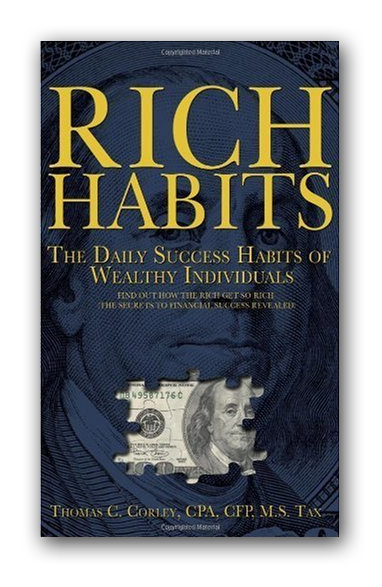
My Rich Habits research has been covered by the media in twenty-seven countries. I’ve done my best to share that research with over thirty million people around the world through my books (Rich Habits, Rich Kids, Change Your Habits Change Your Life and Rich Habits Poor Habits) my blog and through my TV, radio and various other media outlet interviews. In my books, I go into greater detail on this topic, but below are some of the key points I cover in those books on this topic.

Self-made millionaires fall into two categories:

  1. Savers
  2. Risk Takers

Savers

Self-made millionaire Savers accumulate their wealth by living below their means, saving money and then investing that money prudently. According to my Rich Habits research, this path to multi-millionaire status takes about thirty-two years. Savers typically are risk averse, employed most of their lives and have a low or moderate standard of living. Self-made millionaire Savers were among the least wealthy in my study, with an average net worth of $3.4 million. Being a Saver is the risk-free way to building wealth. It’s the safe path to wealth accumulation. It requires discipline, diligence and adhering to a low to modest lifestyle.

Risk Takers

Self-made millionaire Risk Takers are individuals who take some risk in the pursuit of wealth. They are typically business owners, entrepreneurs, aggressive-savvy investors in stocks or real estate or they create some product or service that is so unique they are able to demand a significant premium in return for the purchase or use of their product or service. Self-made millionaire Risk Takers were among the wealthiest in my study, with an average net worth of $7.4 million. Being a Risk Taker is only for the bold and courageous. It’s the high-risk path to wealth accumulation. It requires courage, persistence, cunning and a hard core work ethic.

This article is devoted to the Savers out there – those who wish to become millionaires with little to no risk.

In my study, I found that all Savers have a specific money mindset. Below are some of the top money strategies of self-made millionaire Savers: [Read more…]

The Relationship See-Saw

tip-o-the-morning

Tom Corley boats - crop

We all have our own unique Relationship See-Saw. On one side are the right people and on the other side are the wrong people.

The right people are the people who you associate with every day who are upbeat, positive, enthusiastic, success-minded and have a solutions mindset – they see solutions to every problem.

The wrong people are the people who you associate with every day who are downbeat, negative, listless, defeatists and who have a problems mindset – they see problems as insurmountable.

We are only as successful as those we associate with on a daily basis. If your Relationship See-Saw is tipping in the right direction, this means you have more of the right people on your see-saw and less of the wrong people. They bring solutions to problems. And they are low maintenance, which translates into less stress in your life. This increases your odds for success. The right people lift you up. They remove obstacles and impediments from your path, allowing you to stay focused and to keep moving forward, which increases your chances for succees.

If you have too many of the wrong people on your see-saw, kick them off. They have baggage, that’s filled with problems. And they are high maintenance, which translates into added stress. The wrong people throw wrenches into your life and those wrenches disrupt your focus and stop you from moving forward, which prevents you from achieving success.

You’ve only got one Relationship See-Saw. Make sure it’s tipping in the right direction.

Parkinson’s Law

tip-o-the-morning

Tom Corley boats - crop

Definition of Parkinson’s Law: The perceived complexity and time required for a task’s completion will grow, the longer the task is put off.

Everyone procrastinates. Even wealthy people must fight the urge to procrastinate. The longer you put off completing a task, the harder that task seems. Only by taking action, does one realize that the complexity and time required to complete a task is not as great as imagined. 

The most effective remedy for procrastination is really two things:

  1. Setting a deadline.
  2. Communicating that deadline to an Accountability Partner.

Deadlines define when we must complete the task. Accountability Partners hold us to that deadline.

When we commit to completing a task, by a certain date, to someone we respect or admire, it forces us to take action and complete the task by that deadline. This is why, when it comes to defeating procrastination, accountability partners are critical. We don’t wish to disappoint them and this holds our feet to the fire, forcing us to act.

Dreamlining

tip-o-the-morning

Tom Corley boats - crop

Dreamlining is an interesting strategy shared by Tim Ferris in his book The 4-Hour Workweek. Here’s how it works:

Dreamlining is a strategy in which you group your dreams into two batches:

  1. Six-Month Dreams and
  2. Twelve-Month Dreams

For each batch, list five dreams you would like to realize in six months and then twelve months.

What dreams you should focus on:

  • Being Dreams – Who would you like to be in six months and in twelve months (CPA, Author, Business owner, etc.)?
  • Doing Dreams – What actions would you like to take in six months and in twelve months (traveling, write a book, read X# of books, etc.)?
  • Having Dreams – What would you like to have in six months and twelve months ($10,000, New Home, Baby, etc.)?

In my Dreamsetting strategy, I provide a template for helping you to define your dreams. You can download my free Dreamsetting eBook here. When you combine the Dreamsetting strategy with the Dreamlining strategy, you not only create a blueprint for your ideal, perfect life, you also create a timeline for making that life a reality.


A Needle in the Haystack

tip-o-the-morning

Tom Corley boats - crop

One of the best definitions of main purpose that I’ve come across is as follows:

Engaging in some lifelong activity which you enjoy and that generates a sufficient income to meet your needs and your wants.

When you find your main purpose in life you know it. It is self-evident. There is no doubt.

Your main purpose:

  1. Unleashes Your Creativity
  2. Excites You
  3. Energizes and Inspires You
  4. Exposes Some Innate Talent You Possess
  5. Can be Monetized
  6. Is Fun and Does Not Feel Like Work
  7. Adds Value to the Lives of Others
  8. Is Fulfilling or Makes You Happy

Very few find their main purpose in life. In fact, as the famous author, Henry David Thoreau so aptly put it: “The mass of men lead lives of quiet desperation, and go to the grave with the song still in them.”

For those few who do find their main purpose in life, it’s like you’ve found that needle in a haystack. You feel blessed, fortunate and lucky. Your life seems fulfilled – you are happy. Because you are doing something you love doing, you devote many hours to it, becoming expert in it. And people are happy to pay you a premium for the service or product that results from engaging in your main purpose.

Lottery Players Have a Poverty Mindset

tip-o-the-morning

Tom Corley boats - crop

There are five ways to become rich:

  1. Live Below Your Means – Spend less than earn and save or invest the difference
  2. Expand Your Means – Increase your income via education, starting a business or a side hustle.
  3. Do Both
  4. Inherit Your Wealth
  5. Getting Lucky – Win the lottery


Becoming rich is hard. It requires daily, consistent effort. You must invest time in becoming exceptional in one thing. You have to improve and grow every day. Success requires that you continuously increase and perfect your knowledge and skills. You have to push yourself day after day. You must also force yourself outside of your comfort zone by doing things that are uncomfortable. That’s how you grow, through discomfort, learning, taking risks.

And it’s hard work.

A 2008 study, published in the Journal of Behavioral Decision Making, found that poor people play the lottery more often than the non-poor because lotteries leveled the playing field between the poor and the non-poor – the odds of winning are the same, whether you were rich or poor.

Lotteries are a form of taxation on the poor. And this tax is increasing. In 2014, lotteries contributed $21.3 billion to state budgets, up from $18.2 billion in 2008, according to the Census Bureau.

Many people who are poor have a Poverty Mindset. They believe they have no control over their financial circumstances. They do not believe they can become rich through hard work and initiative. Consequently, they embrace the idea of becoming rich without the effort. That’s why lotteries are so successful. Most would rather take the short cut in becoming rich. They do not want to make the effort because they do not believe they can become rich through hard work, growth or taking risks. 


Sarcasm is a Poor Habit

tip-o-the-morning

Tom Corley boats - crop

There were eleven in my big, Irish-Catholic family. As with most big families, we struggled financially. Our main defense against our financial plight, was humor. We used humor like a balm, to soothe our financial pain.

Oftentimes, that humor took the form of sarcasm. Sarcasm, thus, became a habit for most in my big family.

In my Rich Habits Study, I learned that one of the most important traits of self-made millionaires was the habit of forging long-term relationships with other success-minded people. But forging long-term relationships is a two-step process:

  1. Forging the Relationship and
  2. Maintaining the Relationship

During my study, I realized that sarcasm, even though imbedded inside humor, has the effect of sabatoging relationships.

It took me several years to eliminate my inherited Poor Habit of Sarcasm. And this had the effect of improving all of my relationships. Now that this Poor Habit is in my rear view mirror, I no longer sabatoge my hard won relationships. I’m able to keep them for the long-term.

Forging relationships is hard work. Sarcasm can undo all of that hard work in an instant. If you want to maintain your relationships, avoid sarcasm. Even if it is delivered in the form of humor. Sarcasm can hurt. And if you are the source of hurt, people will make an effort to avoid you.