Circumstances are Temporary, Made Permanent by our Habits

tip-o-the-morning


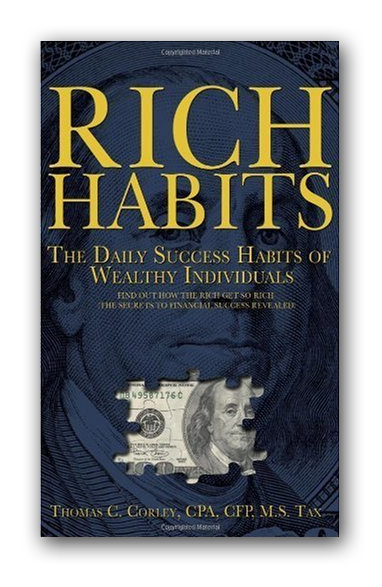
Poverty circumstances are temporary, made permanent by our daily habits. 40% of all of our daily activities are habits (2006 Stanford Study). This means we are all unconsciously moving toward wealth or poverty. It is also the reason you are stuck in the middle-class. Breaking free from poverty or the middle-class is possible. 5-7% of those stuck in poverty, every year, break free from poverty and realize financial success in life. This 5-7% group all have one thing in common: changing their habits, beliefs and behaviors. Breaking free from poverty or the middle-class requires that you adopt new success habits. By adopting just one Rich Habit, such as daily self-improvement reading, you put yourself on a path to success. Adopting two or more Rich Habits accelerates that process. Start small, with one Rich Habit, and watch your life begin to transform before your eyes.

Rich Habits Dad’s Financial Advice to His Recent College Graduate

For those who have kids who are getting older, getting ready to graduate from college or just entering the workforce I would like to share with you an email I sent to my oldest child when he moved out of our home to begin the next phase of his life.
[Read more…]

Spend Your Time Wisely

tip-o-the-morning

There are 1,440 minutes in each day. Rich or poor, time does not discriminate. How you choose to use your 1,440 minutes each day, the choices you make with respect to your time, will dictate your financial circumstances in life. Those who are successful in life spend a portion of their 1,440 minutes in any of the following ways:

  • 30 minutes or more engaged in reading, studying for self-education
  • 30 minutes or more engaged in aerobic exercise
  • 60 minutes or more pursuing some long-term goal, dream or major purpose
  • 15 minutes or more planning their day (i.e. preparing to-do lists)
  • 40 minutes or more networking, volunteering and relationship building
  • 10 minutes or more meditating
  • 30 minutes or more mentoring someone
  • 30 minutes or more writing, speaking, teaching
  • 30 minutes or more developing or learning some skill
  • 20 minutes or more engaged in some creative pursuit
  • 20 minutes or more staying current with events (reading the news)


Happiness Habit #15 – Goal Productivity

tip-o-the-morning

When we are pursuing some goal in life, only then are we truly productive.  Real productivity requires that you incorporate into your day certain tasks that will move you forward toward realizing your goals in life. Productivity, without goals, is just work. It keeps us on the treadmill of life. The only way to get you off that treadmill is to actively pursue a goal. Goal productivity is a Happiness Event because it makes us feel good about ourselves. It creates a feeling of accomplishment and satisfaction.

Happiness Habit #14 – Pursue One Creative Activity for a Month

tip-o-the-morning

Human beings were intended to be creative. It’s hardwired into our DNA. Creative pursuits unleash our inner genius. We all have the creative gene. When we pursue anything creative it triggers positive emotions and creates new neural pathways. Our brains like it when we create new neural pathways so it rewards us with an infusion of neurochemicals that produce a feeling of euphoria. Every time we engage in a creative pursuit we create a Happiness Event. For the next month pursue some creative endeavor. If, after a month, your passion for the activity continues to grow, this means you are on the right track to finding your main purpose in life.  Those who pursue their main purpose in life are the happiest of individuals.

Happiness Habit #13 – Pursue One Long-Term Goal This Year

tip-o-the-morning

While it might seem strange that pursuing a goal is a Happiness Event, research shows that we are genetically engineered to be goal oriented. When we pursue a new goal we activate or create neurons, which then begin firing with each other, creating a new neural pathway. New dentrites and synapses form inside the brain. The brain likes this and releases certain neurochemicals that create a feeling of pleasure or happiness as we learn new things in pursuit of our goal. Every time you learn something new in pursuit of your goal you trigger a happiness event. This physiology is why those who pursue goals consider the pursuit more gratifying than the actual realization of the goal. For the next year find one major, long-term goal you have always wanted to pursue and dive in. You will give yourself a year of Happiness Events. Remember that those with the most Happiness Events in life experience an overall sense of happiness with their lives.

Happiness Habit #12 – Practice Laughter

tip-o-the-morning

Laughter is a Happiness Event. The more you laugh, the more Happiness Events you accumulate in your life. Since the objective for everyone is to live a happy life, laughing is a simple, easy way to create overall happiness. Laughter reduces stress and pain, it also fires up your neurons and, much like aerobic activity, it increases blood flow. It boosts your immune system by creating infection-fighting antibodies and also triggers the release of endorphins, which promote a sense of well-being. For the next month, every day, read something, listen to something or watch something that makes you laugh. Start out your day with a good laugh. It’s like a form of meditation that’s also fun and easy.

Happiness Habit #11 – Associate With Other Happy People

tip-o-the-morning

Birds of a feather flock together. If you want to be happier you need to associate with other happy people. You need to spend a minimum of one hour a week with other happy people. You also need to reduce the time you spend with unhappy people to less than one hour per week. Happy people are generally wealthy, successful people. They are happier than everyone else because they are able to create more happiness events in their lives. But what if you don’t know any wealthy, successful people? What do you do? Where do you find them? You find them on boards and committees of churches, synagogues, food banks, business associations, community sports associations et. al. Many board and committee members of charitable, civic or community organizations are made up of wealthy, successful people.

Spending more time with happy people and less time with unhappy people will change your mindset from negative to positive. It reprograms your mind. Plus, when you make new acquaintances with other happy people they will, in time, introduce you to their relationships, who also happen to be other happy people.

Happiness Habit #10 – Practice Gratitude for One Month

tip-o-the-morning


Have you ever noticed some people are always upbeat, positive, enthusiastic and seem happy? Being in a positive, upbeat emotional state fosters happiness. You may think they are just genetically predisposed to be this way, but you’d be wrong. Wealthy, successful people in my five-year study on the daily habits of the rich have certain Happiness Habits that create this positive mindset. Somewhere along the line these people discovered one of the secrets to happiness: Practicing gratitude. There is always something to be grateful for. Practicing gratitude, every day, provides a reality check on our lives. It stops negative thinking in its tracks. It changes our thinking from negative to positive. When we force ourselves to reflect daily on all of the blessings we have in life (health, a job, a home, a family, friends etc), it stops us from thinking about all the things we don’t have and this changes our perspective. A prerequisite for success in life is to function from a positive mindset. In the world of the wealthy, negative people are not allowed. For the next month make it a habit to practice gratitude. Every day express gratitude for five things you are grateful for in life. Create an attitude of gratitude every day and, in time, you will add another Happiness Habit to your life. The more Happiness Habits you have, the more happiness events you create and the happier you will be overall.

Happiness Habit #9 – Meditate for a Month

tip-o-the-morning

What is meditation? While conscious, our brains vibrate at a rate of twenty cycles per second. This is known as the Beta state. Meditation is the act of slowing your brain vibrations down to the Alpha state – ten cycles per second. Alpha is a conscious state that precedes sleep. It is also considered the creative state, the state where creative ideas flourish; where the subconscious parts of your brain (brain stem and limbic system) are awakened intentionally. Many great inventors and successful entrepreneurs found answers to many of their questions only when their brains were relaxed. To meditate you need to simply close your eyes and relax your mind and body, letting all thoughts pass by like railroad cars on a train track. You can meditate for as little as one minute but many people will meditate for longer periods of time. For people new to meditation I recommend one to three minutes a day.

Why is meditation important?  Meditation is good brain management. It’s like a vacation for the brain. It reduces stress, triggers the creative forces within our subconscious and increases telomerase (an enzyme that keeps telomeres healthy. Telomeres close off each chromosome’s DNA. When telomeres fray, cells die. This is why we age. Our cells stop  dividing and die and this leads to aging).

For the next month, set a goal of meditating for sixty seconds every day in the morning, after waking up, or at night, right before bedtime. It will make you feel more relaxed and induce a state of happiness. Every time you meditate you create a Happiness Event. Overall happiness is dependent on the number of happiness events you have in life. Those with the most Happiness Events in their lives are happier overall than everyone else.