Never Lose Faith in Your Dream

tip-o-the-morning

Tom Corley boats - crop

One of the lessons I’ve learned from studying self-made millionaires is that dreamers are almost always on their own in the beginning phases of pursuing a dream. It’s very hard to find individuals who buy into your dream and are willing to stick it out. Pursuing a dream is all risk. There is no guaranteed payoff and the effort requires an enormous investment in time, and sometimes money.

Finding individuals who buy into your dream is difficult because pursuing a dream is hard work, involves risk and requires persistence and patience. It is a rare breed of individual who will stick with you during your journey. You read about them in books. They have names like Paul Allen (Bill Gates partner), Steve Wozniak (Steve Jobs partner), Charlie Munger (Warren Buffet’s partner), Jamie Dimon (Sandy Weill’s partner) and Todd Wagner (Mark Cuban’s partner). These were apostles who never quit on their famous billionaire dreamers.

Don’t lose faith when people quit on you. Keep working hard every day, pursuing your dream, even when you have to go it alone. Dreamers change the world. And when you experience success, your loneliness ends.

The More You Work the Richer You Become

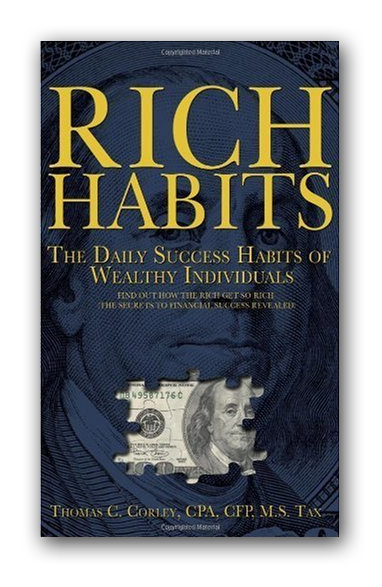
Tom Corley boats - cropAccording to my Rich Habits study, one of the reasons the wealthy accumulated so much wealth was due to the fact that they worked more hours than those who were not rich, or who were poor. Here’s some of the data: [Read more…]

Emotional Pain Can Be a Catalyst for Life Changing Growth

tip-o-the-morning

Tom Corley boats - crop

Think back to the worst emotional pain you experienced in life. Loss of a loved one, broken heart, business failure, getting fired from a job, divorce? Whatever it was that took your legs out from underneath you very likely altered your behavior. It caused you to reevaluate your life. It caused you to engage in some very deep thinking which probably led to some major changes in your life. Were they positive or negative changes?

I’ve learned so many things from studying the habits of self-made millionaires and those struggling with poverty. One of the lessons I learned is that these millionaires had developed a “positive reaction habit” to negative events. Painful events became catalysts for growth. Every mistake, every failure, every heartbreak was fuel for growth. For these millionaires, negative events resulted in positive change. They evolved and became successful.

Conversely, those struggling with poverty developed a “negative reaction habit” to negative events. Painful events became catalysts for isolation, depression and retreat. They devolved and struggled in life.

Emotional pain can be the best thing that can ever happen to you. It can spur you on to improve your life. I inadvertently stumbled onto the “positive reaction habit” when I was nineteen. A girl broke my heart. I moped for weeks, isolated myself from my friends and family and retreated. Then one day one of my friends, Doug Savino, got fed up with my depression. He looked me straight in the eyes and said “man up Tom. Stop crying about it. Show her what a mistake she made in dumping you.” What happened next changed my life forever. I threw myself into weight lifting, school and work. I gained fifteen pounds of muscle in less than a year, took my college grade point average from 3.1 to 4.0 within two years, got on the Dean’s List, worked more hours, which increased my income that I then used to pay for college, thus reducing the amount of student loans I needed. In short, I transformed myself from ordinary to extraordinary. All because someone unknowingly taught me the right way to react to emotional pain – use the pain as a catalyst for growth.

Over the past five years, post-study, I’ve thought a lot about this story of mine. That heartbreak mobilized me because my reaction to it, thanks to Doug, was to grow in a positive way. Most, unfortunately, have never developed the “positive reaction habit”. As a result, they allow themselves to collapse under the weight of their mistakes, failure and heartbreak. They fall into depression. They put up barriers. They devolve. That’s bad.

You will make mistakes, you will fail and you will experience heartbreak. But how you react to those emotional events is what will separate you from everyone else in life. Will you react negatively and devolve? Or will you react positively and evolve? Only you can choose how you react to emotional pain. You must make a habit of reacting positively to emotional pain in order to grow and evolve.


Good Goals vs. Bad Goals – Not All Goals Are Created Equal

tip-o-the-morning

Tom Corley boats - crop

You hardly ever hear anyone talk about goals in a negative context. Goals are almost always perceived to be good. But there are goals that add no real value to your life when achieved yet consume valuable resources. So, how do you know when a goal is good or bad?

Good goals create long-term happiness when achieved. They allow you to grow as an individual and alter your behavior in a positive way. An example of a good goal would be to lose 20 pounds. Setting a weight loss goal often involves a daily regimen of exercise, healthy eating and encourages a healthy lifestyle. Good health results from exercising and eating right. It may also motivate you to moderate your consumption of alcohol or to quit smoking. When the weight eventually comes off you enjoy the compliments, feel healthier and all of this creates lasting happiness.

Bad goals create short-term happiness when achieved. They do not help you grow as an individual, they do not produce long-term benefits and, as such, do not result in long-term happiness. An example of a bad goal would be to own a Ferrari. In order to own a Ferrari you must make more money. Making more money will likely involve either more work or taking excessive financial risk (i.e. gambling). There’s a cost-benefit to working more – you see less of your family. Don’t misunderstand me here. Working more to make more money can be a good thing. But where the goal goes south is when you then use that money to buy stuff, like a Ferrari. The happiness you derive from owning more or better stuff will fade over time, since happiness derived from buying stuff is always short term. You will eventually revert back to your genetic happiness baseline and, after a few weeks, the Ferrari will no longer create lasting happiness. The lost time with the family, however, can never be recouped. If the goal, instead, was to judiciously invest that extra money you earned into a calculated risk, such as a side business, an investment or a vacation home that would enable you to spend more time with your family, then it transforms the “work more/earn more” goal into a good goal.

The benefits of achieving a goal should create some long-term benefit or result in long-term happiness: more time with the family, more personal growth, financial independence, improved health, etc. When the achievement of a goal is to buy more and better stuff, it’s a bad goal. It’s a wasted investment. Be careful of the goals you pursue. Not all goals are created equal.

What Would the Future You Do?

tip-o-the-morning

Tom Corley boats - crop

Success is a process. A big part of that process requires that you create a blueprint of your future life. 500 words is all it takes. 500 words that describe the ideal, perfect future life you desire. When you know where you’re going, it’s much easier to find a route to get there. This is where the abundance of the subconscious mind comes in to play. When you develop this blueprint of your ideal, future life you are effectively turning on the switch to your subconscious mind. To be more specific, you are turning on the switch to something called the Reticular Activating System (RAS), an area of the brain that acts like a traffic cop for all of the information we take in from our senses. This RAS, when turned on, then goes to work seeking external information that will help guide you to the route you need to take in order to arrive at your ideal you destination.

Your blueprint can also act as a guide, directing you in your behavior and decision-making. Through intuition (the subconscious mind communicating with the conscious mind through a bundle of nerves inside the brain known as the corpus callosum) the subconscious can advise you of the correct course of action or to stop what you’re doing. With a blueprint in hand, intuition is a powerful tool unique to humanity. Without a blueprint, intuition has little value.

If you really want to succeed and live a meaningful life it begins by defining who you want to be in the future. Your future you can then come to the rescue. With a  blueprint, you are directed in your actions and choices by the future version of yourself. Your future you then becomes an invaluable resource. It can advise you what to do when faced with obstacles and difficult choices in life.

Unhealthy Thoughts

tip-o-the-morning

Tom Corley boats - crop

Did you know that most of your thoughts are a waste of time and bad for your health? Oftentimes, the thoughts we think are negative and cause us to worry. This leads to stress, which causes a rise in cortisol. Excessive and continued production of cortisol impairs our immune system and opens the door to disease and infection.

Don’t think you think bad thoughts? Have you ever thought about the riots that have been in the news lately? What about all the various murders that are reported by the media? Do you think about them? Were you obsessing over the U.S.-Iraq nuclear deal? How about what Trump said about McCain the other day? Did you give it even a single thought?

Every day I see people interacting on social media about things that are outside their control. Some of the interaction gets heated and its clear those things are causing stress.

Because the media knows we humans have a predilection to think about negative things, the buffet of news includes, for the most part, anything that is negative. And most of those things are completely outside your control. There is virtually nothing you can do about most of the negative things you think about. When you think about negative things you can’t control, it leads to long-term stress because you cannot change the outcome of those negative things and, thus, they will not improve and won’t go away. Those thoughts will repeat inside your brain over and over again causing long-term stress.

You should only be thinking about things you can control in your life. Focus only on thoughts about things in your life you have complete control over. Why? Because you can take action on those things, fix whatever needs to be fixed, and then move on, allowing those thoughts to go away. Stop thinking about things you can’t control. It’s a waste of your time and impairs you health.

What’s Your Weekly 5?

tip-o-the-morning

Tom Corley boats - crop

What are your 5 top priorities for the week? What 5 tasks this week will move your forward toward achieving your goals. List the 5 things that, if accomplished this week, will get you closer to realizing your dreams and wishes. Then pursue each one until completed. Success is a process. The process requires action. What action will you be taking this week that will make you help you grow into the person you need to be in order for success to visit you? Success does not just happen. It doesn’t just manifest itself. You must make it happen. What’s your Weekly 5?


What Should I Know?

Tom Corley boats - crop

Knowledge and learning are the foundation and springboard for success. It’s impossible to know everything, to be a know-it-all. Therefore, you must focus your study on specific areas that will create the greatest return for the time you invest in your learning. Let’s touch on these key areas:

  1. Learn everything about your job and the industry you are in.
  2. Learn everything about the things you are passionate about in life.
  3. Learn everything about the people who are important in your life.
  4. Learn everything about significant current events.
  5. Learn at least one new fact every day.
  6. Learn at least one new word every day.
  7. Learn about one novel thing every month, something outside your comfort zone, that will challenge your thinking.

Process learning every day. Spend at least 30 minutes a day devoted to learning. Learning causes you to grow. Growth is a prerequisite for success in life.

Time is the Only Real Currency

Tom Corley boats - crop

Success is mostly about one thing – time. The accumulation of money is a byproduct of effectively utilizing the limited time we all have. Most millionaires, 76% in my study and between 80-87% in other studies, are self-made millionaires. They achieve success without having much money to invest. So their only real resource is time. They invest their time upfront, hoping they will succeed, hoping the time they invest will pay dividends down the road for them and for their family. So time is the only real investment.

When you start your day today I want you to ask yourself if you are utilizing your time wisely. Are you investing in your future success? Are you working for your success or for someone else’s success? Time is the only real currency. Nothing is more valuable. Invest your time wisely.


Are You Operating at 100% of Your Potential?

Tom Corley boats - crop

You’re preparing tax returns, you’re stocking shelves, you’re painting a house, you’re seeing patients, you’re cleaning houses, you’re working at whatever job that provides for your family. How much of that time do you actually feel you are operating at maximum potential? If you feel that you are hitting it out of the park every day, you are operating at 100% of your potential. You dig what you’re doing. You love your job. And it shows up in your pay check, which is probably significant. Consider yourself blessed. You’re one of 7%.

However, if you’re like most, your mind is often elsewhere. Usually, it’s thinking about what you’d like to be doing if you weren’t doing what you’re doing at the moment. I’ve got some good research on this and the numbers are staggering. Close to 96% of those who do not make much money, don’t like what they are doing for a living. 96%! You don’t like what you’re doing for a living because you’re not living up to your potential. Your potential utilization is far below 100%.

Those who at least like what they’re doing for a living utilize much more of their potential than the average Joe. Those who love what they are doing for a living have a 100% potential utilization rate. The closer you get to that 100%, the more you love what you do, the happier you and everyone in your family is, the more money you make and the wealthier you become. You simply cannot become rich, long-term rich, if you do not at least like what you do for a living.

If you want to be happy and successful in life, you need to get as close as possible to that 100% potential utilization rate. If you’re not even close, you are never going to achieve much in life. Life is short. You were meant to live up to your potential. Are you? What’s your potential utilization? If the answer is “much less than 100%”, then you’re in the wrong line of work and you will never realize financial success or true happiness in life.