Whose Wall is Your Ladder On?

tip-o-the-morning

Tom Corley boats - crop

At the start of my sophomore year in college I was required to pick a major. They call that matriculation – selecting a particular course curriculum in order to receive a specific college degree.

I did what most children do. I asked one of my parents. In this case, my Dad. He told me to pick Accounting – “you’ll never starve,” he said.

What he really meant is that if I became an accountant, I’d never be poor.

That meant a lot to me because we were poor at the time and I didn’t want a poor future.

So, I took my ladder and put it on my Dad’s wall. Then, I proceeded to climb it for 28 years.

I got my CPA (Certified Public Accountant) license. Then I went to grad school at night and got a Masters degree in Taxation. To help my CPA clients manage their money, I got my Series 7 license for financial planning. Then I got my CFP (Certified Financial Planning) license.

By the time I was done climbing my Dad’s wall, it was 2009 and I was age 47, unhappy, unfulfilled and wondering if this is all there was to life.

And that’s when I discovered my purpose in life.

I had always written articles. Most were technical in nature and related to accounting, taxes or financial planning. I wrote hundreds of those articles. But after completing my Rich Habits study I decided to apply my writing skills and write a book about my findings.

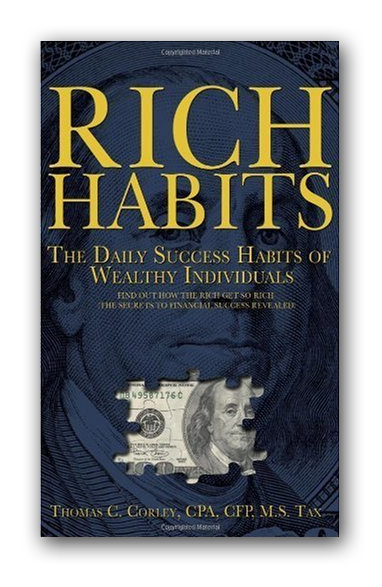
I published my first book, Rich Habits, in 2010. It became a huge bestseller on Amazon. In 2013, Rich Habits rose as high as #7 in all books in the United States. I was ahead of J.K. Rowling, Tony Robbins and even Sheryl Sandberg, whose book at the time, Lean In, was #1 on the NY Times bestseller list. And I stayed in the Amazon top 100 for nearly three weeks.

I’ve since written three other books. I’ve spoken on the same stage as Sir Richard Branson. I’ve spoken to thousands and thousands of people across the United States. I’ve been to Canada and Australia to share my Rich Habits research. I’ve done over 300 media interviews, over 150 radio interviews and dozens of TV interviews. My research has been shared by the media in 25 countries.

I’m not rich yet, like the millionaires in my Rich Habits study. But since I put my ladder on my wall, my income has doubled and I feel happy. My mindset has shifted from negative to positive. I feel energized like never before. I feel optimistic. I see a different future. I see a light at the end of the tunnel. And I know I will be writing until the day I die.

That’s because, for the first time in my life, I am doing what I am supposed to do.

My new life began the minute I decided to put my ladder on my wall.

Don’t waste your life following someone else’s dreams and goals. It’s your life. It’s your ladder. Find your wall to put it on.

Purpose Guarantees Success

tip-o-the-morning

Tom Corley boats - crop

What does it mean to have a purpose?

A purpose is a desire for something that is so intense, it haunts your thoughts even while you sleep.

When you find your purpose, you are able to focus your thinking and actions like a laser. You are able to marshal enormous reserves of unlimited energy.

Purpose provides you with clarity – clarity of vision (your Where, Destination or End Point), clarity of the path you must take (your Road Map or Directions to get you to your Destination) and clarity of action (your How).

When you have a purpose, you are able to overcome every obstacle in your path. With a purpose, failure is never permanent. It is always a temporary thing. A mere setback.

When you have a purpose, achievement is virtually guaranteed. You literally become unstoppable.

Everyone has a purpose. You just have to find out what it is (here’s how). When you do, your life will never be the same.

You Don’t Need Motivation to Succeed in Life

tip-o-the-morning

Tom Corley boats - cropMotivation is a short-term burst of activity that can lead to incredible breakthroughs, incredible performance and incredible productivity.

When motivated, you can work many more hours in a day than the average person. When motivated, you can create a prodigious amount in a short period of time. When motivated, you can push yourself to perform at very high levels.

But, motivation is fleeting. It is hard to sustain.

Those who rely on internal or external motivation do not get very far in life. Eventually, they all lose their motivation. And when that happens, they then burn through their willpower reserves. When they run out of willpower, activity, progress and performance declines significantly or may even cease.

This is why habits are so fundamental to long-term success.

Habits do not rely on temporary bouts of motivation. Habits do not rely on willpower.

Habits, by their very definition, are unconscious behaviors that a person engages in every day, whether or not they feel like it or want to.

Rich Habit #6 – Everything in Moderation.

This is a seemingly short, simple and innocuous little Rich Habit.

Except that it’s not.

Moderation means to moderate everything in your life: How much you work every day. How much you eat every day. How much you drink every day. How much you exercise every day. How much you read every day. How much you (fill in the blank).

Moderating your activities enables you to engage in those activities, every day, every week, every year, for your entire life.

Moderation is all about consistent activity. Those who forge this Rich Habit are able to engage in daily activities that, over time, lead to incredible success.

Survive Until You Thrive – The Daily Mantra of Every Entrepreneur

tip-o-the-morning

Tom Corley boats - crop

“Luck favors the persistent.” – Jim Collins

Thirty-three percent of the self-made millionaires in my Rich Habits study had accumulated $4 million or more during their lifetime. Ten percent had accumulated more than $5 million.

What I found interesting, however, was that 93% of the self-made millionaires in my study did not accumulate that wealth until after age 50. And 79% did not ring the bell until after age 55.

That’s a long time pursuing a dream.

In describing these millionaires, I often like to say – They survived until they thrived.

Literally every month these future millionaires battled just to stay in the game. In fact, some were tossed out of the game – 34% of the self-made millionaires in my study failed at least once in business.

But they were in my study because they got up off the ground and went at it again.

Failure teaches a lot of lessons. Hard lessons. Lessons that are like scar tissue on the brain. Those lessons are only learned, however, if you keep trying. You figure out what to do only after you figure out what not to do.

For those who did pick themselves up after failing, there’s another very interesting little factoid I discovered in my research – the persistent eventually get lucky.

Eighty-seven percent of the self-made millionaires in my Rich Habits study said they would never have become rich if not for luck. At some point during their very long march towards success, luck found them. And boy did it transform their lives.

They went from struggling to pay their bills and fighting to make payroll, to a financial windfall that seemed to come out of the blue. But that windfall did not come out of the blue. It was something each self-made millionaire in my study was building up to year after year.

Success is a process. A big part of that process is persistence. You never get lucky if you quit. You get lucky when you persist. Luck is the reward for persistence.

Never quit on your dream. Luck does not visit quitters.

America’s First Billionaire

Tom Corley boats - crop

I love researching self-made millionaires, especially those who rise from the bottom. These individuals are unique because the circumstances of their lives are often dire and set against them, more so than the average poor person.

That’s why I’ve spent some months researching and studying the life of Cornelius Vanderbilt.

Vanderbilt, or Commodore, as he was often called, was raised in Port Richmond, a primarily Dutch village on Staten Island, New York. His parents, Cornelius and Phebe Vanderbilt, came from nothing. “Low Dutch”, is what many called them.

Vanderbilt made his millions by controlling two burgeoning industries: the steamboat industry and the railroad industry.

When he died, Vanderbilt’s estate was estimated to be worth $100,000,000. That was back in 1877. In today’s dollars, that would be approximately $2.3 billion, making him the richest man in America, at the time.

But, in the early 1830’s there were many very talented people who were building a prosperous nation. So, what made Vanderbilt so unique?

Cornelius Vanderbilt possessed many of the Rich Habits: [Read more…]

The Rich Are Frugal – The Poor Are Cheap

tip-o-the-morning

Tom Corley boats - crop

Cornelius Vanderbilt, the richest man in the world in the late 1800’s, controlled much of America’s transportation in two sectors – the steamships and the railroads.

He was revered for his ability to minimize costs. His attention to financial details was unsurpassed during his reign.

For example, when he took over the New York Central Railroad, one of the first things he did was remove all of the brass from all of the trains. This cost him a lot of money in removing all of the brass from his rail cars. People thought he was crazy.

Why did he do it?

Brass needed to be polished every day. No brass, meant no more need to pay people to polish it every day.

Eliminating the expense of polishing the brass far and away exceeded the cost of its removal, saving his railroad companies an enormous amount of money in the long run.

Rich people find novel ways to stretch their money.

Poor people, on the other hand, spend their money foolishly. They focus on the short term – the cost of the product always comes first. Quality rarely enters their mind.

They will buy a cheap product, just to have it, despite the fact that the quality of the product is suspect. After a few years, the product wears down and they are forced to buy another cheap product or do without.

Be frugal, not cheap. Being frugal is a Rich Habit. Being cheap is a Poor Habit.

Self-Awareness is a Superpower

tip-o-the-morning

Tom Corley boats - crop

The unaware are all around you.

The person who walks through a door, oblivious that you are right behind them, letting the door slam in your face.

The driver who cuts you off on the highway.

Or the overweight person, eating junk food, watching TV, oblivious to the fact that they are destroying their health.

It’s not selfishness that drives these people. It’s not even an entitlement or elite mindset.

It’s a lack of self-awareness.

The fact is, most people lack self-awareness. They are completely unaware of what is going on internally – their thoughts, emotions and behavior. They are also unaware of what is going on externally – their environment.

There are plenty of studies that support this. There are even videos of people completely unaware of their external environment. Here’s one I like called the bear on the porch.

Self-awareness, however, is a real superpower for the few who possess it.

Self-awareness allows you to recognize your own thoughts, emotions and behavior. Self-awareness also allows you to see what is going on all around you in your environment. Self-awareness enables you to pivot in order to avoid obstacles, pitfalls, mistakes and toxic people who get in the way of your success.

Self-made millionaires make a daily habit of developing this Self-Awareness Superpower Habit. And it’s one of the reasons they become self-made millionaires.

Self-awareness helps you do many things:

  • Self-awareness enables you to see your strengths and weaknesses. This helps you to focus on what you are good at and find others who are happy to do what you are bad at.
  • Self-awareness enables you to identify your good and bad habits. This helps you to identify habits that help you succeed and eliminate habits that get in the way of success.
  • Self-awareness enables you to identify toxic people. This helps you to avoid being used, abused or dragged into other peoples troubled lives. Toxic people are like potholes along your path to success. They make the journey bumpy and difficult.
  • Self-awareness enables you to see dangers, obstacles and pitfalls that are oblivious to others. This saves you time, money and emotional anguish.
  • Self-awareness enables you to identify the lessons found in mistakes. This helps you grow and improve.
  • Self-awareness enables you to step into the shoes of others and see what they see. This helps you empathize with others. This also helps you when you are negotiating with others.

Self-awareness is a Superpower Rich Habit that is critical to success. Without it, success is virtually impossible.

Everyone Wants to be on Top of the Mountain But Few Are Willing to Make the Climb

tip-o-the-morning

Tom Corley boats - crop

When things don’t go as planned, most people quit the struggle and move on to greener (meaning – easier) pastures.

And the world is filled with quitters.

Without pursuing success, life is a struggle. Even for the vast majority who are content with just coasting along, life is still filled with problems. Most people want to minimize their problems. They don’t want to add more problems to their lives.

That’s why self-made millionaires are so rare.

According to my Rich Habits research, only 3% who pursue a dream, stick with it until they succeed. At some point, 97% quit.

Here’s why. The pursuit of a dream, big goal or major initiative means – more problems. More obstacles to overcome. More pitfalls to crawl out of. More conflict. More stress. More emotional heartache, especially when things don’t go as planned. And when you’re pursuing a dream, big goal or major initiative, nothing ever goes as planned.

The pursuit of success is all about facing problems. And realizing success is all about solving those problems you face along the journey.

Not surprisingly, most avoid pursuing their dreams. They look at the mountain they must climb and say to themselves – “too many problems”.

For the courageous few who throw caution to the wind and take action on their dreams, their life becomes a seemingly never ending battle to overcome problems.

There’s just no sugar coating it – the pursuit of success is an uphill climb that requires many years of problem solving.

But, for the 3% who refuse to quit on their dreams, success is inevitable. Those 3% learn an enormous amount during their journey as a result of solving problems.

Plus, when you persist, eventually you get lucky. Luck favors the persistent. That unexpected luck, like a ski-lift, carries you effortlessly up the rest of the mountain.

The key, therefore, is to persist until luck finds you.

When you get to the top of your mountain, the first thing you will notice is that there are not that many people. That’s because all of the people are at the bottom of the mountain looking up at you.

Everyone want to be on top of the mountain. It’s just, not that many people are willing to climb it.

Consistent Success

tip-o-the-morning

Tom Corley boats - crop

Everyone wants to be successful, but few know how or where to begin.

Success is a process. Just like failure is a process.

The struggle to become successful, I learned from my Rich Habits study, is figuring out that process.

Most pursue success the hard way – Trial and Error.

After years of taking action on their dreams, they learn what to do and what not to do. They learn from their mistakes and failures.

According to my Rich Habits research, this Dream path takes about 12 years. Twelve years of trial and error.

Unfortunately, this long time horizon causes most to quit long before they ever realize their dreams.

But there is a better, easier way.

Consistency, I discovered is the key to success.

The self-made millionaires in my Rich Habit study pursued success every day by forging good daily habits that automated success.

Forging good daily habits, or Rich Habits, is the way you gain that consistency.

Good habits put you on autopilot for success because they automatically imbue you with consistency.

When you have good habits, you don’t need passion. You don’t need motivation. You don’t need willpower. You don’t need confidence.

Success doesn’t require any of those things.

In fact, most of the self-made millionaires in my study succeeded because they did not rely on passion, motivation, willpower or confidence. Instead, they relied on habits.

When you forge good daily habits, your path to success is virtually guaranteed because, every day, you are consistently doing what it takes to succeed. Consistency is the path to success and good daily habits are the key that opens the door to that path.

Passion, motivation, willpower and confidence, come and go. Good habits, however, are there to stay. Once forged, they never come and go. They just go. Every day.

Good daily habits overpower everything that stops success in its tracks: loss of passion, loss of motivation, loss of willpower, uncertainty and doubt.

Focus on forging good daily habits and the pursuit of success becomes a consistent daily habit.

Three Cs To Avoid

tip-o-the-morning

Tom Corley boats - crop

I’m not a big fan of affirmations but there is one affirmation I use every day and it’s this:

Never Criticize, Condemn or Complain

Each one of these Poor Habits drags you down, creating a negative mindset.

You want to avoid them like the plague.

They have the opposite effect of a magnet – pushing people away from you.

You want to be a magnet for people, not a deflector beam that pushes people away from you.

Those who constantly criticize, condemn and complain are negative, toxic people who must be avoided at all costs. They will drag you down with their negativity.

Plus, because they are constantly offending others, if you are associated with these toxic people, you too will be labeled as toxic and that will negatively affect your ability to build relationships with others.

Toxic people spread their negativity like a virus throughout their social network. And they are very easy to identify because they – Criticize, Condemn and Complain.