Success Beliefs of the Rich

Tom Corley boats - crop

In my Rich Habits study I discovered that your beliefs dictate your circumstances in life. Those who are wealthy have different beliefs than those who are poor or stuck in the middle-class.

Beliefs represent the acceptance of something without any proof to back up what we accept as fact. They are inherited unconscious programming. We adopt the beliefs of our parents, family, mentors culture and our environment (neighborhood, town, city, state, country). Most who were raised in poverty, inherited limiting beliefs that hold them back in life.

Those who are able to rise from poverty and become wealthy found mentors who possessed success beliefs or employed certain strategies that enabled them to remove their limiting beliefs and implant success beliefs, effectively re-programming their entire belief system.

The wealthy adopt certain beliefs that promote success:

  • I must read to learn.
  • I am responsible for the circumstances of my life.
  • Money and wealth are good.
  • There is an abundance of money and wealth to go around.
  • Anyone has the ability to become wealthy. I can become wealthy.
  • I can solve any problem.
  • I can overcome any obstacle.
  • I create my own luck.
  • Opportunities are everywhere.
  • Opportunity does not knock. I have to go out and find it and take action.
  • I must earn respect.
  • Failure is just another way to learn.
  • Failure is the stepping stone to success.
  • Risk is good when it is calculated risk.
  • There is good debt and bad debt.
  • No one succeeds on their own. I can only succeed if I surround myself with other success-minded people.
  • I can accomplish anything I put my mind to.
  • Time is the most valuable resource. I must make efficient use of my time. Wasting it is a crime.
  • Birds of a feather flock together. I will avoid toxic people and surround myself with success-minded people.
  • Dreams and goals are the rungs on the ladder of success.
  • If I help others succeed, I will succeed.
  • If I improve the lives of others, I will improve my life.
  • Always exceed the expectations of others.
  • I am in control of my thoughts and emotions.
  • Never quit on a dream.
  • Success takes time.
  • I must save more than I earn and invest my savings in my dreams and goals.
  • I am amazing and unstoppable.

If you want to succeed in life, if you want to become rich, you need to understand the beliefs you currently have and then do some surgery. For a week, write down in a notepad every belief that pops in your head. This belief awareness exercise enables you to isolate any limiting beliefs that are likely holding you back in life. Once you’ve identified those limiting beliefs, then it’s time to remove them and add the beliefs that will enable you to become rich and successful.

So, how do you remove limiting beliefs and implant success beliefs?

  • Associate with individuals who do not have your limiting beliefs and who possess the success beliefs you want to adopt.
  • Read books and articles on self-made millionaires.
  • Read inspirational books and articles.
  • Listen to inspirational podcasts.
  • Watch and listen to inspirational TEDx talks.
  • Create daily affirmations around the success beliefs you want to adopt.
  • Meditate and focus on your new success beliefs (10-15 minutes a day is all it takes).

Your existing beliefs were formed over many years. It takes time to re-program you belief system. How long? At least one year of dedicated effort. But that one year investment will pay you dividends for the rest of your life. Your future you will thank you.


Success Beliefs

tip-o-the-morning

Tom Corley boats - crop

In my Rich Habits study I discovered that your beliefs dictate your circumstances in life. Those who are wealthy have different beliefs than those who are poor or middle-class.

Beliefs = the acceptance of something without any proof to back up what we accept as fact.

Beliefs = unconscious programming.

Beliefs are primarily inherited conclusions. We adopt the beliefs of our parents, family, culture and environment. 

The wealthy adopt certain beliefs that promote success:

  • I must read to learn.
  • I am responsible for the circumstances of my life.
  • Money and wealth are good.
  • There is an abundance of money and wealth to go around.
  • Everyone has the ability to become wealthy.
  • I can solve any problem.
  • I can overcome any obstacle.
  • I create my own luck.
  • Opportunities are everywhere.
  • Opportunity does not knock. I have to go out and find it and take action.
  • I must earn respect.
  • Failure is good.
  • Failure is a learning experience.
  • Failure is the stepping stone to success.
  • I can accomplish anything I put my mind to.
  • Time is the most valuable resource. I must make efficient use of my time. Wasting it is a crime.
  • Birds of a feather flock together. I can only succeed if I surround myself with other success-minded people.
  • Dreams and goals are the rungs on the ladder of success.
  • If I help others succeed, I will succeed.
  • If I improve the lives of others, I will improve my life.
  • Always exceed the expectations of others.
  • I am in control of my thoughts and emotions.
  • Never quit on a dream.
  • Success takes time.
  • I must save more than I earn and invest my savings in my dreams and goals.
  • I am amazing.


Success Mentors Tee You Up For Success and Happiness

tip-o-the-morning

Tom Corley boats - crop

In a study conducted by Yagi Tadash (Doshisha University) and Nishimura Kazuo (Kobe University), in which 5,000 adult men and women were questioned about their parents, they found that the environment these adults were raised in dictated their future success, wealth and happiness in life.

The study found that supportive parents had the most significant impact on an individual’s future success and happiness in life.

Even individuals raised in a poor household, in which parents were supportive, had better grades, greater happiness and higher income later in life.

If you were not fortunate enough to have been raised in a supportive household, all is not lost. I’ve written often about the importance in finding success mentors in life. Finding a success mentor is the fast track and seamless path to success. Mentors smooth out the path for you in life.

Mentors are everywhere. You just have to seek them out. They are in your neighborhood, volunteering at non-profits, at work, at school, in books and on the Internet.

Don’t be a victim, whose life is dictated by their current circumstances. Finding a success mentor will enable you to alter your circumstances. Don’t let fear hold you back from asking someone to mentor you. Make finding your success mentor your life’s obsession.

How to Become an Expert

tip-o-the-morning

Tom Corley boats - cropAnders Ericsson is the world expert on experts. What he found in his research was that experts practice deliberately every day. The Japanese call this Kaizen – continuous improvement.

Experts engage in deliberate practice for at least ten years in order to become the best at what they do.

Deliberate practice requires that you set a stretch goal, one not easily achieved, and then practice every day until you reach that goal.

It might be running a mile in less than 4 minutes.

It might be becoming a best-selling author.

It might be becoming a CPA, CFP or a Doctor.

Each stretch goal sets your destination. Deliberate practice helps you create daily habit goals that help achieve your stretch goals, moving you closer to your destination.

Deliberate practice also requires feedback. And this is what separates the experts from the rest of the field. Experts practice and then seek feedback from others. Feedback lets you know what you did wrong, allowing you to tweek what you’re doing, refining your practice, in order to perfect your skills.


The Binder System

tip-o-the-morning

Tom Corley boats - crop

I’ve been using something I call the Binder System since I discovered it during my Rich Habits Study. The Binder System helps you in your quest for success. Each binder is a tool in your success tool belt.

Fact Binder

In my research, I found that self-made millionaires were dedicated to daily growth and daily self-improvement. Each day, they sought to increase their knowledge through reading, listening to audio books, listening to podcasts, watching educational video, attending seminars, webinars, tele-seminars, participating in formal or informal mastermind groups and asking questions of others to gain more insight and expertise. This enabled them to grow their knowledge each day to help them evolve into the person they needed to become in order to realize success.

While reading is important, retaining important information uncovered in your reading is critical to learning new facts and information. One strategy to do this is the Fact Binder. In your Fact Binder create various topic sections that are meaningful to you. Each day, after reading, add any new facts or information to your Fact Binder. You can even add a section titled: “New Words” where you add any new words you come across in your reading. Writing down what you read has a way of reinforcing what you just read. Abraham Lincoln would write things down 3 times in order to commit them to memory. The physical act of writing somehow acts to create a new neural pathway that allows the new facts or information to stick. Once a week go over the new information you added. That will help reinforce the learning.

Mistake Binder

The Mistake Binder is a running list of every mistake you make in life. Each mistake is documented on one page. You want to document four things on that one page: WHAT went wrong WHY did it go wrong HOW to avoid repeating it in the future LESSON you learned The goal is to get into the habit of filling your Mistake Binder with page after page of mistakes that you make. Then spend a few minutes every other week reviewing your Mistake Binder. This helps make the learning stick and will also keep the mistakes in working memory, acting like a radar system, alerting them when you are about to repeat a mistake. The Mistake Binder will take the taboo out of making mistakes and will change your negative perception regarding mistakes. You’ll soon find yourself embracing your mistakes and the lessons they teach.

Book Binder

This is a binder where, in 1-2 pages, you summarize the key points of every book you read. This binder gives you immediate access to these key points at any time.

Vision Binder

The Vision Binder includes a picture of every dream that you one day hope to realize. It gives you instant access to each dream, allowing you to easily document and review each dream. By periodically  reviewing each dream, you help consolidate it into long-term memory, allowing your subconscious to go to work behind the scenes to help you make your dream a reality.

Goal Binder

In this binder you list every one of the goals you want to accomplish in order to help you realize each one of your dreams. In my Goal Binder I put at the top of each page one dream. Then, on the same page, I list all of the goals I will need to achieve in order for that dream to be realized. In the Goal Binder each dream is your destination and the goals are your GPS – how you get there.

Temporary vs. Long-Term Habits

tip-o-the-morning

Tom Corley boats - crop

In my research on the habits of self-made millionaires I discovered two types of habits that these millionaires used to help them achieve success: Temporary vs. Long-Term Habits.

Temporary Habits

With Temporary Habits you develop daily habits that make it possible for you to accomplish a short-term goal.

Developing study habits to help you obtain a degree, license or certification is an example. Another example might be writing a book, completing a project, manufacturing a prototype product, or saving money for a year for a down payment on a home.

Temporary Habits don’t necessarily stick with you for life. They last for as long as you need them to last.

 Long-Term Habits

These are habits that stick with you for life. They help build the infrastructure for a better life. Examples include reading every day to learn, practicing a skill every day, exercising daily to improve your health, eating healthy every day, daily habits that promote a positive mental attitude (i.e. expressing gratitude every day or meditating).

Long-Term habits are like the foundation of a building. In the context of a life, they represent habits that lay the foundation for a good, healthy, happy and successful life.


How to Eliminate Beliefs That Are Keeping You Poor

Tom Corley boats - crop

We all have negative and limiting beliefs that hold us back in life. Most of these beliefs came from our parents and were forged during our early childhood years, prior to the age of nine. These negative and limiting beliefs cause us to develop habits that hold us back in our adult lives. Most are not even aware of the negative and limiting beliefs they have. These beliefs prevent us from becoming successful in life and in many cases they act like an anchor dragging us down into failure, poverty and a life of misery. If you want to be wealthy and successful in life you need to remove and replace these negative and limiting beliefs. Here’s how: [Read more…]

Seek Discomfort

tip-o-the-morning

Tom Corley boats - crop

When you do anything that is challenging, when you are learning something new, when you are developing a new skill or when you meet new people, you will feel discomfort.

Discomfort is a minor form of stress and a little stress is a good thing, it turns out.

The latest research on stress indicates that minor stress elevates your ability to focus.

It sharpens your cognitive abilities by releasing certain hormones and neurotransmitters that tap into all three parts of the brain: the neocortex, limbic system and the brain stem.

This is important because, well three parts of the brain are better than one, obviously. But more to the point, when our limbic and brain stem are called into action, the power of emotions charges in. And emotions are the key to long-term potentiation (long-term memory).

Emotions make learning stick.

So, embrace discomfort. Welcome it. Seek out situations in life that put you in a state of discomfort. Discomfort causes change and growth. And growth is the hallmark of all successful individuals.

4 Self-Made Millionaires Who Failed and Bounced Back

Tom Corley boats - crop

“Our greatest glory is not in never falling, but in rising every time we fall.” Confucius

As children we are programmed to believe that failure is bad. If you fail a test it negatively impacts your grade for the course. Fail enough tests and you will fail the course. Teachers call parents, parents yell at child. When we become adult we get bad grades in life by taking risks. As a result, we avoid taking risks in life in order to avoid failure.

Well most of us. The ones who don’t shy away from taking risks that could lead to failure are called self-made millionaires. Self-made millionaires somehow are able to re-program their minds in order to see failure as a good thing, learning experience, rather than as a bad thing. Failing, for self-made millionaires, helps them learn what what works and what does not work.

I thought I’d share some real-life stories of millionaires who failed and whose failure brought them to the brink of financial ruin, only to rise like a phoenix out of the ashes of failure. [Read more…]

Change Your Habits, Change Your Life #1 on Amazon and iTunes – Here’s Why

Tom Corley boats - crop

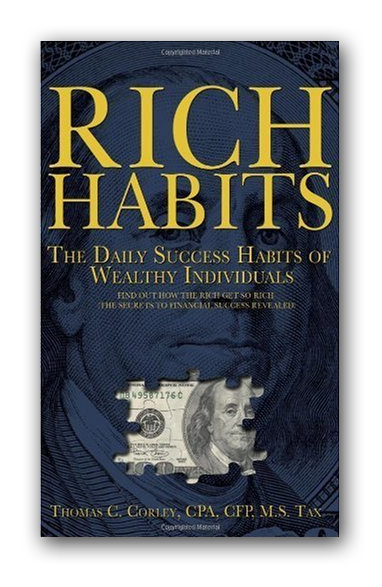
I spend a great deal of time reading the Amazon reviews of my books. Particularly, the 1 and 2 star reviews. Rich Habits, 1st Edition had some critics, although 67% awarded it mostly 5 stars. Almost 100% of the criticism had one common theme: Where’s The Beef? We fixed that with my upcoming book Rich Habits Poor Habits, which expands the number of Rich Habits and Poor Habits from 10 to 30. Also, we have included two bonuses:

  • The Research Summary, listing the data on over 200 habits that separate the rich and the poor. This Research Summary has received an enormous amount of media attention in the U.S. and in 24 other countries.
  • Rich Habits Poor Habits Test – a 50 question test you can take to find out if you are on the path to wealth or poverty or fall somewhere in the middle.

We will be releasing Rich Habits Poor Habits in the fall of 2016. We believe it will become a blockbuster, international best seller, right up there with Think and Grow Rich and other timeless classics.

My newest book – Change Your Habits, Change Your Life, continues to receive 5 star reviews. right out the gate. What readers love about this book is it’s ability to boil down complex topics into simple to understand language, making it easier to apply the strategies included in the book. It’s a powerful book and I was fortunate to get a back cover endorsement from none other than Jack Canfield, bestselling author of Chicken Soup for the Soul. Jack is in the Guinness World Book of Records – he holds the record for the most books ever published by an author: 500 million books! Jack doesn’t endorse books without good reason. Within two weeks of releasing Change Your Habits it rose to #1 on Amazon  and iTunes and stayed there for two weeks. I am getting calls and emails from the media in all parts of the world who love the book and I am receiving astonishing reviews on Amazon. Here are some recent reviews from my readers on Change Your Habits, Change Your Life: [Read more…]